

Geomembrane Liner CQA Field Inspection & Hold-Point Checklist: Subgrade, GCL, Dual-Track Welding and Dipole ELL
In short: Research across geoelectric leak-location surveys (Forget, Rollin & Jacquelin; Nosko & Touze-Foltz) demonstrates that 70% to 73%+ of defects in installed landfill liners occur during placement of the overlying stone drainage layer rather than at welded seams alone. A rigorous Construction Quality Assurance (CQA) field checklist must enforce hold points from subgrade proof-rolling and GCL overlap through HDPE trial welds, 100% non-destructive seam testing, protection geotextile installation, and post-gravel ASTM D7007 Dipole Electrical Leak Location.
- 1Subgrade acceptanceLine, level, compaction and freedom from sharp objects
- 2Material conformanceCertificates and independent conformance testing
- 3Panel deploymentLayout, overlaps and weather conditions checked
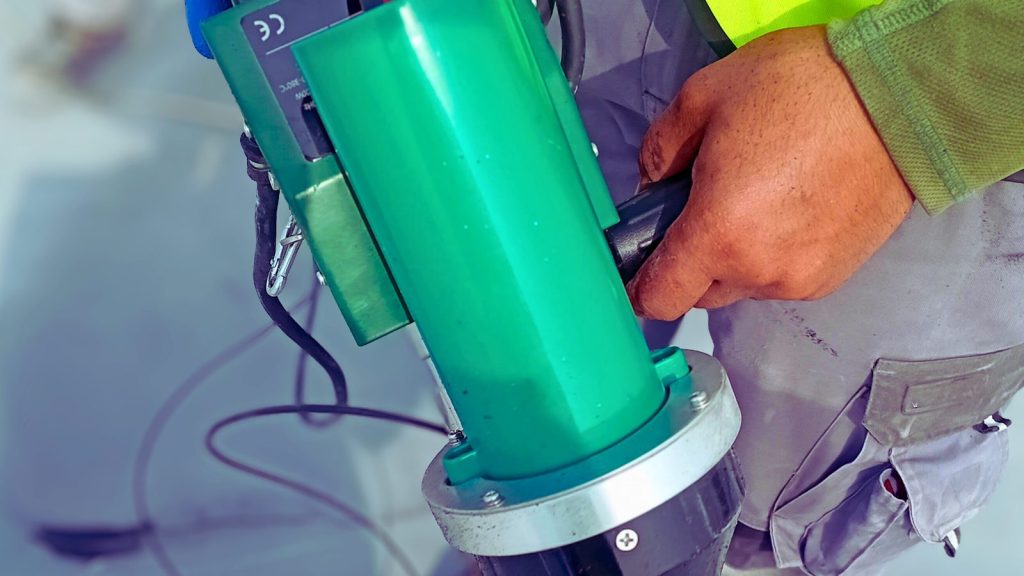
- 4Trial weldsMachine and operator qualified before production welding
- 5Seaming and NDTAir-channel and vacuum-box testing of every seam
- 6Destructive testsSeam samples tested in shear and peel
- 7Leak location surveyElectrical survey before and after cover placement
- 8Sign-offHold point released only with complete records
Key facts
- 70%–73%+ of liner holes detected in leak-location surveys are mechanical punctures caused during aggregate drainage-layer placement [1][2].
- Trial welds must be executed on site at the start of each shift and whenever ambient sheet temperature changes significantly (GRI-GM19 / ASTM D6392) [2].
- 100% of dual-track hot-wedge seams must undergo non-destructive air-channel pressure testing (e.g., ~2.0 bar / 30 psi for 5 min with ≤0.2 bar drop) [2].
- Post-gravel Dipole Electrical Leak Location (ASTM D7007 / LGG 113) detects stone-placement punctures before waste filling begins [1][2].
Plain English — the essentials, in everyday language
Plain English
What this topic covers and why it matters in practice
Research across geoelectric leak-location surveys (Forget, Rollin & Jacquelin; Nosko & Touze-Foltz) demonstrates that 70% to 73%+ of defects in installed landfill liners occur during placement of the overlying stone drainage layer rather than at welded seams alone. A rigorous Construction Quality Assurance (CQA) field checklist must enforce hold points from subgrade proof-rolling and GCL overlap through HDPE trial welds, 100% non-destructive seam testing, protection geotextile installation, and post-gravel ASTM D7007 Dipole Electrical Leak Location.
How the four-stage operational pathway works
To apply this guidance reliably, project teams and students should follow four sequential stages: (1) 1. Subgrade & GCL Hold Point (Smoothness, Moisture, ≥300 mm Overlaps); (2) 2. HDPE Deployment & Shift Trial Welds (Peel & Shear Pass in Field Tensiometer); (3) 3. 100% Seam NDT (Air-Channel Pressure + Vacuum Box on Extrusion Welds); and (4) 4. Cushion Geotextile, Low-Ground-Pressure Gravel Placement & Dipole ELL Survey. Each stage has a clear verification check before moving to the next.
Professional layer — engineering, operations & compliance detail (click to expand)
Professional
Engineering, Regulatory & Quality-Control Requirements
70%–73%+ of liner holes detected in leak-location surveys are mechanical punctures caused during aggregate drainage-layer placement [1][2]. Trial welds must be executed on site at the start of each shift and whenever ambient sheet temperature changes significantly (GRI-GM19 / ASTM D6392) [2]. 100% of dual-track hot-wedge seams must undergo non-destructive air-channel pressure testing (e.g., ~2.0 bar / 30 psi for 5 min with ≤0.2 bar drop) [2]. Post-gravel Dipole Electrical Leak Location (ASTM D7007 / LGG 113) detects stone-placement punctures before waste filling begins [1][2]. Practitioners must verify current permit conditions, laboratory test methods, and competent authority guidelines before finalising project specifications or operational procedures.
Field Implementation & Documentation Checklist
1. Establish baseline records for 1. Subgrade & GCL Hold Point (Smoothness, Moisture, ≥300 mm Overlaps). 2. Implement documented controls for 2. HDPE Deployment & Shift Trial Welds (Peel & Shear Pass in Field Tensiometer) and 3. 100% Seam NDT (Air-Channel Pressure + Vacuum Box on Extrusion Welds). 3. Retain auditable certificates, weighbridge logs, or inspection records for 4. Cushion Geotextile, Low-Ground-Pressure Gravel Placement & Dipole ELL Survey in the project quality register.
Common questions
Where should project teams verify the primary requirements for Geomembrane Liner CQA Field Inspection & Hold-Point Checklist?
Always consult the primary instrument or technical guideline published by the competent authority (Geosynthetic Institute GRI-GM13/GM19 & UK Environment Agency LGG 113) alongside site-specific permit conditions [1].
Can general guidance replace a site-specific engineering or legal review?
No. Knowledge Hub articles explain the technical and regulatory structure, but project decisions must be based on the approved project design, laboratory data, and competent authority instructions.
References
Show all 2 sources
- Geosynthetic Institute GRI-GM13/GM19 & UK Environment Agency LGG 113 (2025). Official Primary Reference. Available at: https://geosynthetic-institute.org
- United Arab Emirates (2018) Federal Law No. (12) of 2018 on Integrated Waste Management. Available at: https://elaws.moj.gov.ae
About this article
Charmaine Frost is a landfill gas and waste-management specialist and a founding director of Qualifrost FZC LLC, drawing on UK Tier-1 operational and engineering experience with major waste-management companies. She holds the NEBOSH International General Certificate and has submitted her final NEBOSH Diploma assessment, with results expected in March–April 2027.
Reviewed by Adrian Frost, Director. Checked against primary statutory instruments and recognised technical standards.