

Principles of the Circular Economy: The Butterfly Diagram and Cradle to Cradle
In short
The circular economy is an economic model designed to keep materials in use rather than discarding them. It rests on three principles set out by the Ellen MacArthur Foundation: eliminate waste and pollution by design, circulate products and materials at their highest value, and regenerate natural systems. Its central image, the butterfly diagram, separates two kinds of flow. The biological cycle returns food and natural materials safely to the soil. The technical cycle keeps manufactured products circulating through maintenance, reuse, refurbishment and recycling. Cradle to cradle is the design philosophy underneath: materials should be designed from the outset to re-enter one cycle or the other.
Key facts
- The circular economy rests on three principles: eliminate waste and pollution, circulate products and materials, regenerate nature [1]
- The butterfly diagram separates biological and technical cycles, with inner loops preferred because they retain more value [1]
- The UAE has approved and implemented 22 circular economy policies under the Circular Economy Agenda 2021–2031 [2]
- Organic waste is about 40% of UAE municipal waste, making the biological cycle the larger near-term opportunity [3]
- Only metals achieve a net societal benefit in the EU waste system; every other material stream carries a net cost [4]
- The EU-wide societal cost of waste management is EUR 68 per tonne, or EUR 304 per citizen per year [4]
- Global material circularity remains low, with recycling meeting only a small fraction of material demand [5]
Plain English — the essentials, in everyday language
Plain English
The problem with the old model
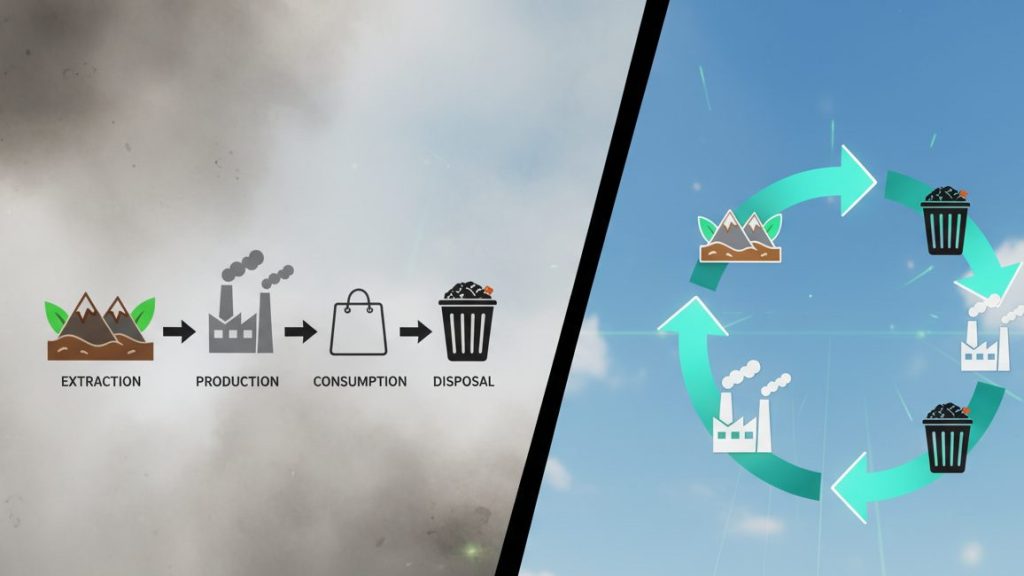
For most of industrial history the economy has worked in a straight line: take, make, use, throw away. Raw materials are extracted, turned into products, used for a while, then buried or burned.
This is called the linear economy. It only works while raw materials stay cheap and there is somewhere to put the waste. Neither holds indefinitely.
What circular means
A circular economy keeps materials in use instead of discarding them. It is not simply recycling more. Recycling is the last resort within a circular system, not its main idea.
Three principles define it [1]:
1. Eliminate waste and pollution by design. Most waste is decided at the drawing board. A product glued together cannot be repaired. A pack made of three bonded materials cannot be recycled. Waste is a design failure, not an inevitability.
2. Circulate products and materials at their highest value. Keep the thing itself in use if you can. Repair it, resell it, refurbish it. Only break it down for materials when you must.
3. Regenerate nature. Return biological materials safely to the soil so the natural systems we depend on improve rather than degrade.
The butterfly diagram
The best-known image of the circular economy looks like a butterfly with two wings [1].
The left wing is the biological cycle. Food, timber, cotton and other natural materials can safely return to the earth through composting or anaerobic digestion, rebuilding soil.
The right wing is the technical cycle. Metals, plastics and manufactured goods cannot return to the soil. They must keep circulating through maintenance, reuse, refurbishment, remanufacture and finally recycling.
Inner loops are better than outer loops. Repairing a washing machine keeps far more value than shredding it for scrap steel. The tighter the loop, the more value stays in the economy.
Cradle to cradle
Cradle to cradle is the design idea behind the butterfly. Instead of designing a product from cradle to grave, you design it so that its end is the start of something else.
It asks one question at the design stage: when this is finished with, which cycle does it belong to? A material that fits neither cycle cleanly is a design problem.
In the UAE and the Gulf
The policy framework is real and active. The UAE Circular Economy Agenda 2021–2031 has produced 22 approved and implemented policies, covering extended producer responsibility, source separation, a national materials database, and rules on tyres, waste oil and recycled content [2].
Organic waste is the biggest single opportunity. It makes up about 40% of UAE municipal waste [3]. That is the biological cycle, and it is currently mostly landfilled, where it produces methane.
Construction dominates by weight. Rapid building means construction and demolition waste is the largest stream in most GCC cities. Concrete and aggregate are technical-cycle materials with genuine reuse value. Abu Dhabi’s Tadweer Group and Dubai Municipality both operate recovery routes for inert construction material.
Cheap disposal weakens the business case. Dubai Municipality charges AED 100 per tonne for general waste [6]. Where burying material is inexpensive, circularity has to be driven by policy and design rather than by disposal cost alone.
What it means for you
- Buy things that can be repaired, and repair them
- Choose single-material packaging over multilayer where you have the choice
- Separate food waste properly. It is the largest biological-cycle stream in the region
- Ask suppliers what happens to a product at end of life. The question changes behaviour
Professional layer — engineering, operations & compliance detail (click to expand)
Professional
Applying the hierarchy of loops
Value retention falls sharply as loops widen. In descending order of retained value:
| Loop | Action | Value retained | Typical barrier |
|---|---|---|---|
| Maintain | Service, repair | Highest | Design prevents disassembly |
| Reuse | Resell, redistribute | High | No reverse logistics |
| Refurbish | Restore to working order | Moderate–high | Warranty and liability |
| Remanufacture | Rebuild to as-new spec | Moderate | Core recovery rate |
| Recycle | Reduce to material | Lowest | Contamination, market price |
Recycling is the loop of last resort. Programmes that measure success by recycling rate alone will systematically under-invest in the higher-value loops.
Measuring circularity
Recycling rate is a weak proxy. Better indicators:
- Material circularity indicator — proportion of material flow that is restorative
- Material flow analysis — mass balance across a defined system boundary
- Product lifetime and repair rate — direct measure of inner-loop performance
- Recycled content by mass — verifiable, auditable, procurement-relevant
For carbon claims, follow ISO 14040/14044 for life cycle assessment [7], and be explicit about system boundary. A circularity claim without a stated boundary is not auditable.
The economic reality
The JRC and Technical University of Denmark assessment of the entire EU waste system found societal cost of EUR 68 per tonne, EUR 136 billion annually, EUR 304 per citizen. Only metals achieve a net societal benefit [4].
That finding matters for business cases. A circular intervention is not automatically economically positive. Metals have strong intrinsic value and mature markets; plastics, biowaste and mineral waste are the most expensive streams to manage. Design the intervention around where value actually exists.
Regulatory drivers
UAE. The Circular Economy Agenda 2021–2031 and Circular Economy Council coordinate policy, with 22 policies implemented covering EPR, source separation, materials data and sector-specific lifecycle rules [2]. Federal Law No. 12 of 2018 provides the integrated waste management framework.
EU. The Waste Framework Directive embeds the waste hierarchy in law and requires separate collection [8]. The Circular Economy Action Plan drives eco-design and recycled content requirements.
Standards. ISO 14001:2026, published 15 April 2026, strengthens life-cycle thinking and extends control to externally provided processes, products and services — a direct circular-economy lever inside the management system [9].
Practitioner notes
- Start with material flow analysis, not with a recycling target. You cannot design loops for flows you have not measured
- Reverse logistics is the binding constraint in the Gulf. Take-back schemes fail on the return leg, not the forward one. Cost it explicitly before designing a scheme
- Design-stage intervention beats end-of-pipe every time. Once a multilayer pack exists, no downstream technology fixes it economically
- Beware circularity claims without a boundary. “100% recyclable” means nothing unless collection, sorting and a reprocessing market all exist where the product is sold
Common questions
Is the circular economy just recycling? No. Recycling is the last loop, used when a product cannot be maintained, reused, refurbished or remanufactured. A system judged only on recycling rate misses most of the available value [1].
What is the butterfly diagram? The Ellen MacArthur Foundation’s illustration of two material cycles. The biological cycle returns natural materials to the soil; the technical cycle keeps manufactured products circulating. Inner loops retain more value than outer ones [1].
What does cradle to cradle mean? A design approach where products are designed so their components can safely re-enter either the biological or technical cycle at end of life, rather than becoming waste.
Is the UAE doing anything on circular economy? Yes. The Circular Economy Agenda 2021–2031 has delivered 22 implemented policies covering extended producer responsibility, source separation, a national materials database and sector-specific lifecycle rules [2].
Does circular always save money? Not automatically. EU analysis found metals are the only material stream achieving a net societal benefit; plastics, biowaste and mineral waste all carry net cost [4]. The business case has to be built stream by stream.
References
Show all 9 sources
- Ellen MacArthur Foundation (2024) The butterfly diagram: visualising the circular economy. Available at: https://www.ellenmacarthurfoundation.org/ (Accessed: 25 August 2026).
- Khaleej Times (2025) UAE innovative policies strengthen new, circular economy pathways. Reports 22 approved and implemented circular economy policies under the UAE Circular Economy Agenda 2021–2031. Available at: https://www.khaleejtimes.com/business/uae-innovative-policies-strengthen-new-circular-economy-pathways-3 (Accessed: 25 August 2026).
- Fast Company Middle East (2026) UAE’s circular economy goals hinge on stronger organic waste management. Reports organic waste at nearly 40% of UAE municipal waste. Available at: https://fastcompanyme.com/news/uaes-circular-economy-goals-hinge-on-stronger-organic-waste-management/ (Accessed: 25 August 2026).
- European Commission Joint Research Centre and Technical University of Denmark (2025) Comprehensive assessment of environmental and economic impacts of the entire EU waste management system. JRC141204. Available at: https://publications.jrc.ec.europa.eu/repository/handle/JRC141204 (Accessed: 25 August 2026).
- Circle Economy (2025) Circularity Gap Report. Available at: https://www.circle-economy.com/ (Accessed: 25 August 2026).
- Dubai Municipality (2026) Waste disposal gate fee schedule 2026. General and organic waste AED 100/t. Confirm current rates with Dubai Municipality before commercial reliance.
- International Organization for Standardization (2006) ISO 14040:2006 Environmental management — Life cycle assessment — Principles and framework. Available at: https://www.iso.org/standard/37456.html (Accessed: 25 August 2026).
- European Union (2008) Directive 2008/98/EC on waste (Waste Framework Directive), Art. 4 (waste hierarchy). Available at: http://data.europa.eu/eli/dir/2008/98/oj (Accessed: 25 August 2026).
- International Organization for Standardization (2026) ISO 14001:2026 Environmental management systems — Requirements with guidance for use. Published 15 April 2026. Available at: https://www.iso.org/standard/14001 (Accessed: 25 August 2026).
Related articles
Start here – The Waste Hierarchy
Related – Linear vs Circular Models – Design for Disassembly / Recyclability – Extended Producer Responsibility (EPR) – Circular Economy in the Gulf
Go deeper – Circular Economy KPIs & Metrics – Industrial Symbiosis – Financing Circular Economy – Carbon Footprint & Life Cycle Assessment
About this article
Charmaine Frost is a landfill gas and waste-management specialist and a founding director of Qualifrost FZC LLC. Her experience was gained with major UK waste-management companies, covering landfill gas generation and collection systems, environmental monitoring and the practical risks of landfill operations. She holds the NEBOSH International General Certificate and has submitted her final NEBOSH Diploma assessment, with results expected in March–April 2027.
Reviewed by Adrian Frost, Director. Every article is checked against primary sources before publication: legal claims are verified against the instrument itself, and figures against the original dataset.
Published 25 August 2026 · Last reviewed 25 August 2026 · Next review August 2027, or sooner if the law changes.