

Gulf Waste Composition & Seasonal Variation: High Organic Moisture, Packaging Fractions and Calorific Value (LHV)
In short: Typical Gulf municipal solid waste (MSW) comprises 35% to 50% organic food and kitchen waste, 15% to 22% paper and cardboard, 11% to 16% plastics, 3% to 5% metals, 2% to 4% glass, and 10% to 20% textiles, nappies, and fines. This composition yields an as-received Lower Heating Value (LHV) of 8.5 to 11.0 MJ/kg—well above the World Bank guideline of an average of at least 7 MJ/kg (never below 6 MJ/kg in any season) for autothermal Waste-to-Energy combustion without auxiliary fuel.
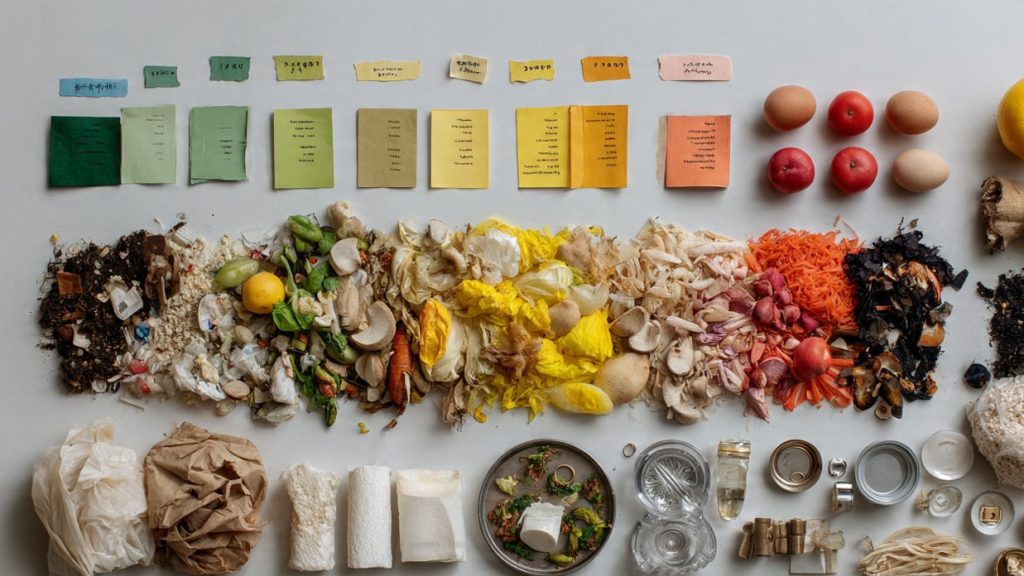
Key facts
- Organic food and green waste represents 35%–50% by wet weight of mixed GCC municipal solid waste [1][2].
- Dry recyclables (paper/cardboard 15%–22%, plastics 11%–16%, metals 3%–5%, glass 2%–4%) make up ~35%–45% of GCC MSW [1].
- As-received mixed MSW in the UAE and KSA typically has moisture content of 35%–48% and Lower Heating Value (LHV) of 8.5–11.0 MJ/kg [2][3].
- During Ramadan, organic food waste fraction increases by 15%–25%, shifting wet bulk density and moisture content upward [1][2].
Plain English — the essentials, in everyday language
Plain English
What is actually inside a Gulf household bin
If you empty and sort an average municipal waste collection truck in the UAE or Saudi Arabia by weight, roughly 40% of the weight is food and organic kitchen waste, 18% is paper and cardboard, 14% is plastic bottles, tubs, and bags, 4% is metal cans, 3% is glass, and the remaining 21% is a mix of textiles, disposable nappies, wood, and swept sand/dust [1][2].
Why sand and moisture matter to waste engineers
Two local factors make Gulf waste distinct from European waste: first, high fruit, vegetable, and cooked-rice discards create wet pockets in mixed bins that stain cardboard if not separated at source; second, windblown desert sand (inert ash fraction) enters outdoor skips, increasing abrasion on shredder blades and raising bottom-ash mass in thermal plants.
Professional layer — engineering, operations & compliance detail (click to expand)
Professional
Executing a Bankable Waste Characterisation Study (ASTM D5231 / SWA-Tool)
Before lenders will finance a Waste-to-Energy plant, MRF, or anaerobic digester, the project sponsor must conduct a multi-season Waste Characterisation Study following ASTM D5231 (Standard Test Method for Determination of the Composition of Unprocessed Municipal Solid Waste) or the European SWA-Tool methodology [3]: (1) stratify incoming RCV collection vehicles across high-density apartments, low-density villas, commercial/retail routes, and traditional markets; (2) cone-and-quarter representative vehicle loads down to 91–136 kg (200–300 lb) sorting samples; (3) hand-sort into 15 to 28 primary and secondary material categories across at least two climatic seasons plus Ramadan; and (4) perform laboratory proximate analysis (moisture, volatile matter, fixed carbon, ash) and ultimate analysis (C, H, O, N, S, Cl, plus heavy metals and bomb-calorimeter Higher/Lower Heating Value).
Tanner Triangle & Firing Diagram Envelope for Gulf WtE Boilers
Using Dulong’s formula and wet-basis moisture corrections (LHV_wet = LHV_dry × (1 - W) - 2.442 × W), Gulf mixed MSW typically sits comfortably inside the self-sustaining Tanner Triangle (Moisture < 50%, Ash < 60%, Combustibles > 25%), delivering an as-received LHV of 8.5 to 11.0 MJ/kg [2][3]. If aggressive plastic recycling removes high-calorific polyolefins (LHV ~38–42 MJ/kg) while food waste remains unsegregated, LHV_wet drops toward 7.5–8.5 MJ/kg; conversely, if source-separated food waste is also diverted to anaerobic digestion, the residual waste dries out and LHV_wet stabilizes near 9.5–10.5 MJ/kg.
Common questions
What minimum Lower Heating Value (LHV) is needed for a Waste-to-Energy plant to burn waste without auxiliary fuel?
The World Bank's Municipal Solid Waste Incineration: A Decision Maker's Guide (1999) recommends that the annual average as-received LHV be at least 7 MJ/kg, and that it must never fall below 6 MJ/kg in any season [2].
Why is chlorine (Cl) measured in waste characterisation studies?
Chlorine (primarily from PVC plastics and salty food waste) forms hydrochloric acid (HCl) gas during combustion, which causes high-temperature superheater tube corrosion above 400°C–420°C steam temperatures and requires lime/bicarbonate flue-gas scrubbing [2][3].
References
Show all 3 sources
- Tadweer Group & SCAD (2024) Abu Dhabi Waste Statistics and Composition Baseline. Abu Dhabi. Available at: https://tadweer.ae/en
- World Bank (1999/2018) Municipal Solid Waste Incineration: A Decision Maker's Guide and What a Waste 2.0. Washington, DC: World Bank. Available at: https://openknowledge.worldbank.org
- ASTM International (2016) ASTM D5231-92(2016): Standard Test Method for Determination of the Composition of Unprocessed Municipal Solid Waste. West Conshohocken, PA: ASTM. Available at: https://www.astm.org
About this article
Charmaine Frost is a landfill gas and waste-management specialist and a founding director of Qualifrost FZC LLC, drawing on UK Tier-1 operational and engineering experience with major waste-management companies. She holds the NEBOSH International General Certificate and has submitted her final NEBOSH Diploma assessment, with results expected in March–April 2027.
Reviewed by Adrian Frost, Director. Checked against primary statutory instruments and recognised technical standards.