

Plastic & Packaging Waste in the Gulf: Polymer Streams (PET, HDPE, PP, LDPE), Single-Use Bans and Recovery
In short: Plastic waste represents 11% to 16% by mass of municipal solid waste across the GCC, driven by high bottled-water consumption and retail packaging. Effective recovery depends on separating high-value rigid polymers—primarily Resin Code 1 (PET) and Resin Code 2 (HDPE)—from contaminated flexible films (LDPE/LLDPE), enforcing the UAE’s 2024–2026 single-use plastics ban (MR 380/2022), and scaling food-grade bottle-to-bottle rPET plants.
Key facts
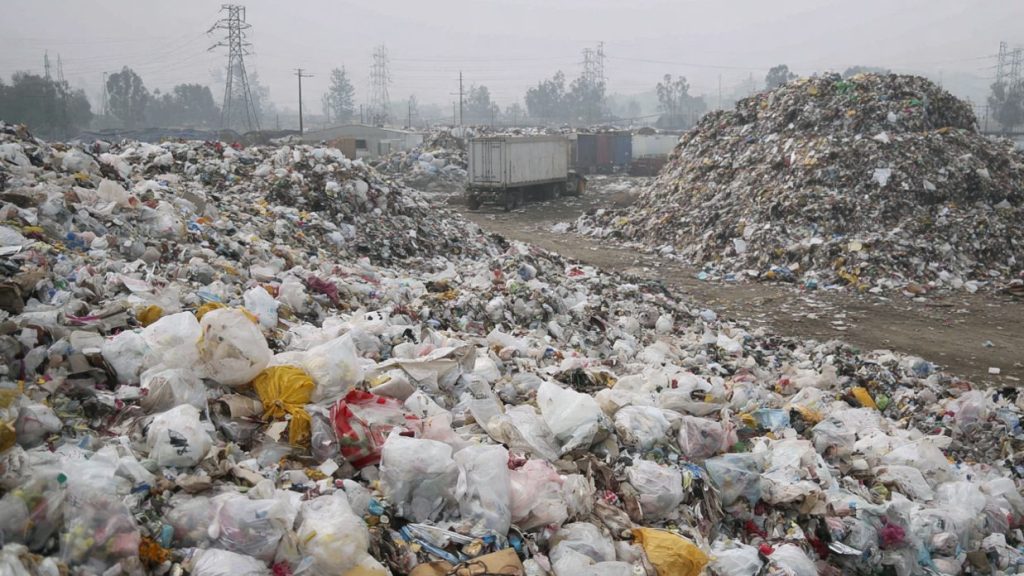
- Plastics account for 11%–16% of GCC municipal solid waste by weight, exceeding global middle-income averages [1].
- Only PET (#1), HDPE (#2), and clean PP (#5) consistently achieve positive net market value in mechanical MRF sorting [2].
- Abu Dhabi and Dubai host industrial-scale food-grade bottle-to-bottle rPET recycling plants processing >20,000–35,000 tonnes/year [3].
- UAE Ministerial Resolution No. (380) of 2022 banned single-use plastic shopping bags in 2024 and expanded to single-use cups, cutlery, plates, and Styrofoam in Jan 2026 [4].
Plain English — the essentials, in everyday language
Plain English
Why the numbers 1 to 7 inside the recycling triangle matter
The number inside the chasing-arrows triangle on a plastic container is its Resin Identification Code (1 to 7)—it tells you what polymer the item is made from, NOT that it is automatically recyclable in every kerbside bin [2]. In the UAE, #1 PET (clear water and soft-drink bottles), #2 HDPE (milk jugs, detergent and shampoo bottles), and #5 PP (rigid food tubs and bottle caps) are the most widely recycled polymers. By contrast, #3 PVC, #6 PS (Polystyrene/Styrofoam), and #7 Other (multi-layer pouches) are difficult to recycle mechanically and frequently contaminate sorting lines.
How water bottles become new water bottles in the UAE
When you place a clean PET water bottle into a recycling bin or Reverse Vending Machine (RVM) in Abu Dhabi, Dubai, or Sharjah, it is baled at a Material Recovery Facility (MRF) and sent to a local bottle-to-bottle rPET plant (such as Veolia/Repeet in Abu Dhabi or BariQ/industrial reprocessors in the region). There, bottles are optically sorted, shredded into flakes, hot-washed, decontaminated under vacuum (Solid-State Polycondensation — SSP), and extruded into food-grade rPET pellets for new beverage bottles [3].
Professional layer — engineering, operations & compliance detail (click to expand)
Professional
Polymer Density, NIR Reflectance & MRF Separation Engineering
In a modern Gulf MRF, 3D rigid plastics are separated from 2D paper/film on ballistic separators, followed by Near-Infrared (NIR) optical sorters operating at 1,100–2,200 nm to eject PET, HDPE, and PP into dedicated bunkers (>95% purity) [2]. Note that carbon-black pigments absorb NIR wavelengths, rendering black plastic trays invisible to standard NIR sensors unless mid-wave IR or AI-vision cameras are installed. In the wet flake line, sink-float hydrocyclones separate polyolefins (HDPE/PP density 0.90–0.96 g/cm³, which float in water) from PET (density 1.33–1.38 g/cm³, which sinks).
Food-Contact rPET Certification (EFSA / US FDA / UAE MOIAT)
To supply recycled PET into beverage preforms in the UAE, the decontamination reactor (e.g., Starlinger iV+ or Vacurema SSP) must be validated by challenge testing in line with US FDA guidance on recycled plastics in food packaging (resulting in a Letter of No Objection), EFSA evaluation under Regulation (EU) 2022/1616, and applicable UAE Ministry of Industry and Advanced Technology (MOIAT) food-contact requirements, ensuring surrogate contaminants are reduced below 0.15 µg/kg migration limits [3].
Common questions
Should I leave the plastic cap on a PET water bottle when recycling?
Yes, if the bottle is emptied and crushed: modern wash lines shred the bottle and cap together and separate the floating PP/HDPE cap flakes from the sinking PET flakes in a water density bath, whereas loose caps fall through MRF screens into residual waste [2].
Why is flexible plastic film (cling wrap and carrier bags) excluded from most kerbside bins?
Flexible 2D films wrap around rotating disc screens and shafts inside MRFs, requiring manual shutdowns to cut free, and carry high food/moisture contamination that degrades mechanical extrusion [2].
References
Show all 4 sources
- UNEP and ISWA (2024) Global Waste Management Outlook 2024. United Nations Environment Programme. Available at: https://www.unep.org/resources/global-waste-management-outlook-2024
- WRAP (2024) Plastic Packaging Sorting and Recycling Technical Guidance. WRAP UK. Available at: https://www.wrap.ngo
- Tadweer Group & EAD (2025) Abu Dhabi PET Bottle Recovery and Circular Packaging Initiatives. Available at: https://tadweer.ae/en
- UAE Ministry of Climate Change and Environment (2022) Ministerial Resolution No. (380) of 2022. Available at: https://www.moccae.gov.ae
About this article
Charmaine Frost is a landfill gas and waste-management specialist and a founding director of Qualifrost FZC LLC, drawing on UK Tier-1 operational and engineering experience with major waste-management companies. She holds the NEBOSH International General Certificate and has submitted her final NEBOSH Diploma assessment, with results expected in March–April 2027.
Reviewed by Adrian Frost, Director. Checked against primary statutory instruments and recognised technical standards.