

Secure Landfill: Design Differences from MSW Landfills
A hazardous waste landfill looks superficially like a municipal one and is engineered to an entirely different standard. This guide sets out the containment, leachate, acceptance and monitoring differences, and explains why waste acceptance criteria rather than liner thickness are the defining control.
By Charmaine Frost, Director and Landfill Gas Specialist
In short
A secure landfill accepts hazardous waste under a containment and acceptance regime substantially more stringent than municipal practice. The defining difference is regulatory rather than structural: acceptance is governed by measured leaching behaviour against defined criteria rather than by waste description [1]. Waste must be tested for basic characterisation, the tests used must include those used for compliance testing, and each load must be visually inspected before and after unloading with documentation checked [1]. Separate landfill classes exist for inert, non-hazardous, hazardous, monofill and solidified monolithic waste [1].
Key facts
- Waste acceptance is governed by leaching criteria and total content rather than by waste description, with criteria set at EU level for inert waste and at Member State level for some parameters [1].
- Waste must generally be tested to obtain basic characterisation information, and the tests used for characterisation must always include those to be used for compliance testing [1].
- Each load delivered must be visually inspected before and after unloading and the required documentation checked, with verification permitted at the point of dispatch for producer- controlled sites [1].
- Separate landfill classes cover inert waste, non-hazardous waste (including inorganic waste with low organic content and, in separate cells, stable non-reactive hazardous waste), hazardous waste with its own acceptance criteria (including underground storage), monofills, and landfills for solidified monolithic waste [1].
- Stable and non-reactive means leaching behaviour will not change adversely in the long term under landfill design conditions or foreseeable accidents [1].
- Sampling and testing must be carried out by independent qualified persons and institutions, with laboratories holding proven experience and an efficient quality assurance system [1].
- Wastes destined for secure landfill must contain no free liquid by the paint filter test and generally achieve a minimum strength, with 50 psi typically specified [2].
- Hazardous waste attracts a Dubai gate fee of AED 550 per tonne against AED 100 for general and organic waste [3].
Plain English — the essentials, in everyday language
Plain English
The fundamental difference
A municipal landfill is designed around a simple premise: contain the waste, collect the leachate and gas, and let biology run its course over decades.
A secure landfill is designed around a different premise. The waste will not degrade. Whatever is placed there stays chemically what it is, essentially forever.
That changes everything about the design.
Acceptance is the real control
The most important difference is not the liner. It is what you are allowed to put in.
Waste is accepted on the basis of measured leaching behaviour, not on what it is called [1].
Two wastes with the same description can have completely different leaching characteristics. Only testing establishes which cell, if any, will take them.
The three-stage acceptance process
Basic characterisation is the full assessment of a waste stream, establishing composition and leaching behaviour and determining which landfill class can accept it [1].
Compliance testing verifies that subsequent loads match the characterised waste. Critically, the tests used for characterisation must always include those used for compliance testing [1].
On-site verification checks each load. Every delivery is visually inspected before and after unloading and the documentation is checked [1].
Landfill classes
Landfills are classed by what they may accept. Hazardous waste landfills, including underground storage, have their own acceptance criteria; stable, non-reactive hazardous waste placed in separate cells at non-hazardous landfills is a different route [1]:
Landfill for inert waste, with leaching and organic content criteria set at EU level.
Landfill for inorganic non-hazardous waste with low organic content.
Cells within non-hazardous landfills that may take stable, non-reactive hazardous waste.
Monofills, taking a single waste type.
Landfills for solidified, monolithic waste.
What stable and non-reactive means
This phrase does a lot of work, and it has a precise definition.
It means the leaching behaviour will not change adversely in the long term under landfill design conditions or foreseeable accidents. Specifically [1]:
Not through processes in the waste alone, such as biodegradation.
Not under long-term ambient conditions, meaning water, air, temperature and mechanical stress.
Not through the impact of other wastes, including leachate and gas from them.
That third point matters. A waste can be stable on its own and unstable next to something else.
Containment design
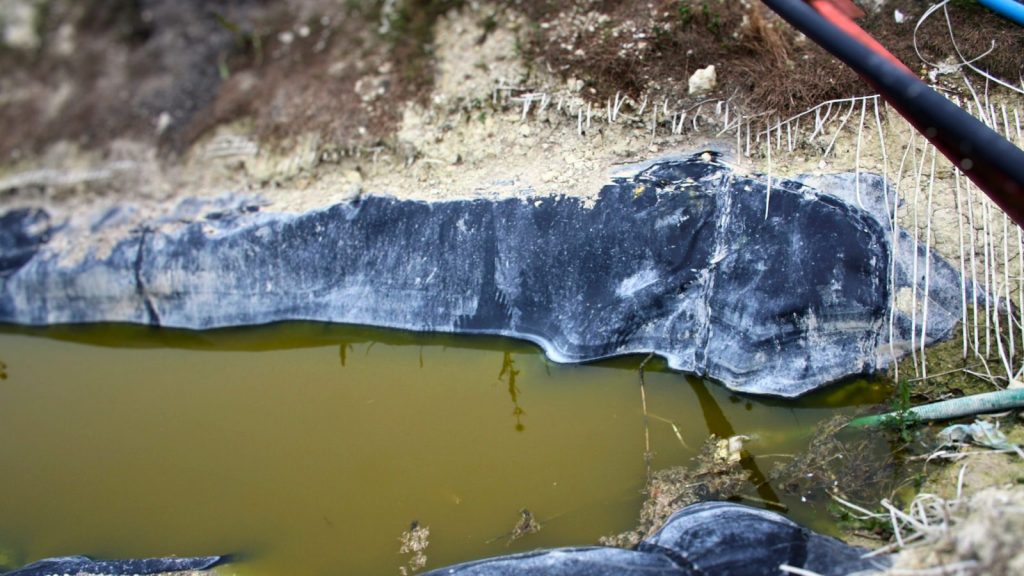
The liner system is more robust than municipal practice, typically a double composite: two geomembranes, each over a low-permeability clay or geosynthetic clay layer, with a leak detection layer between them.
The leak detection layer is the key addition. If the upper liner fails, liquid arrives in that layer and is detected and removed before it reaches the lower liner.
Leachate collection sits above the upper liner, and heads are kept low because head drives leakage through any defect.
No free liquids
A defining rule. Wastes going to secure landfill must contain no free liquid, determined by the paint filter test [2].
Liquids migrate, pressurise the collection system and defeat containment. So liquids are treated or solidified first.
Treated wastes also generally need a minimum strength so they can bear the weight of waste placed above them, with 50 psi typically specified [2].
Segregation within the site
Incompatible wastes must be kept apart. Acids and cyanides together release hydrogen cyanide. Acids and sulphides release hydrogen sulphide. Oxidisers with organics create fire risk.
So cells are dedicated by waste type, and placement is recorded.
Records last forever
Municipal landfill records matter for decades. Secure landfill records matter indefinitely, because the hazard does not decay.
Knowing exactly what is in which cell is a permanent obligation.
The Gulf position
Regional hazardous landfill capacity is limited, which is reflected in gate fees. Dubai charges AED 550 per tonne for hazardous waste against AED 100 for general and organic waste [3].
ADNOC’s BeAAT facility at Ruwais applies concrete immobilisation before disposal to designated landfill, which is the standard sequence.
Professional layer — engineering, operations & compliance detail (click to expand)
Professional
Design premise
The engineering premise of a secure landfill differs fundamentally from municipal practice.
A municipal landfill accommodates biological degradation: gas generation, settlement, leachate that evolves from acidic and organic to ammoniacal, and progressive stabilisation over decades.
A hazardous waste landfill accommodates none of that. Inorganic hazardous wastes do not degrade, so the containment must function for as long as the hazard persists, which for heavy metals is indefinite.
Three consequences follow. Containment redundancy is required rather than preferred, because there is no natural attenuation of the hazard over time. Waste acceptance becomes the primary control, because what is excluded never needs containing. And record-keeping becomes a permanent obligation rather than a time-limited one.
Waste acceptance as the primary control
Regulatory design places acceptance criteria, not construction specification, at the centre.
Council Decision 2003/33/EC has no legal force in the UAE, where acceptance criteria come from Cabinet Resolution No. 39 of 2021, emirate rules and site permits; it is used here as the most detailed international benchmark. Under the Decision, basic characterisation must establish the landfill class at which the waste may be accepted, any additional precautions to be taken at the landfill, and whether the waste can be recycled or recovered [1].
As a general rule waste must be tested to obtain that information. In addition to leaching behaviour, the composition of the waste must be known or determined by testing, and the tests used for characterisation must always include those to be used for compliance testing [1].
That last requirement is the enforcement mechanism. Compliance testing on routine loads is meaningful only where the same analytical determinands were established at characterisation, so the two stages are deliberately coupled.
On-site verification completes the chain. Each load of waste delivered shall be visually inspected before and after unloading and the required documentation checked, and for waste deposited by the producer at a landfill under their own control this verification may be made at the point of dispatch [1].
Sampling and testing for basic characterisation and compliance must be carried out by independent and qualified persons and institutions, with laboratories holding proven experience in waste testing and analysis and an efficient quality assurance system [1]. Sampling may be carried out by producers or operators subject to conditions [1].
Landfill classification
The regulatory structure defines classes by acceptable waste rather than by construction type [1]:
Landfill for inert waste, accepting inert waste, with criteria for leaching and for content of organic components set at EU level and criteria for inorganic content optionally set at Member State level.
Landfill for non-hazardous waste, accepting inorganic non-hazardous waste with low organic and biodegradable content, class B1a, where criteria for leaching and total content are not set at EU level.
Cells within non-hazardous landfills accepting stable, non-reactive hazardous waste, class B1b, subject to the criteria in section 2.2.2 of the Decision.
Storage facilities, monofills and landfills for solidified, monolithic waste, which are possible for all landfill classes.
Treatment is the mechanism connecting classes. Where waste is hazardous under the waste list, treatment may have enabled it to meet the criteria for placement of stable, non-reactive hazardous waste in non-hazardous waste landfills within cells for inorganic waste with low organic and biodegradable content, and the waste may be granular, rendered chemically stable, or solidified and monolithic [1].
The stability requirement
Stable, non-reactive means the leaching behaviour of the waste will not change adversely in the long term under landfill design conditions or foreseeable accidents, specifically not in the waste alone for example by biodegradation, not under the impact of long-term ambient conditions such as water, air, temperature and mechanical constraints, and not by the impact of other wastes including waste products such as leachate and gas [1].
Member States must set criteria ensuring the waste has sufficient physical stability and bearing capacity, and must set criteria ensuring hazardous monolithic wastes are stable and non-reactive before acceptance in landfills for non-hazardous waste [1].
The third limb of the definition, impact of other wastes, is the one most often overlooked in practice. A stabilised residue may be demonstrably stable in isolation and become unstable in contact with leachate from a co-disposed acidic waste, because acid attack degrades the cementitious matrix. Co-disposal compatibility is therefore an acceptance question, not merely an operational one.
Dissolved organic carbon provisions illustrate the flexibility built into the criteria: where a value is not achieved, a higher limit may be admitted by the competent authority provided the DOC value of 800 mg/kg is achieved at a liquid to solid ratio of 10 l/kg, either at the material’s own pH or at a pH between 7.5 and 8.0 [1].
Containment engineering
Secure landfill containment applies redundancy that municipal design does not require.
Double composite lining is standard: an upper composite of geomembrane over geosynthetic clay liner or compacted clay, a leak detection and collection layer, and a lower composite of the same construction. The lower system functions as a secondary barrier and the intermediate layer provides the means of demonstrating primary liner performance.
Leak detection is the operational value of the arrangement. Flow arriving in the intermediate layer indicates a primary liner defect, is measurable, and is collected and removed before it reaches the secondary barrier. Municipal single composite systems provide no equivalent diagnostic.
Chemical compatibility of liner materials with the specific waste is a design requirement absent from municipal practice. Geomembranes are polymeric and are attacked by certain solvents and oxidisers. Immersion testing of the specified liner material in representative leachate is appropriate where aggressive wastes are accepted, alongside hydraulic conductivity screening of the treated waste itself [6].
Leachate collection above the primary liner maintains low head, since leakage through any defect scales with head. Collection pipework must be chemically resistant and accessible for cleaning, because encrustation and clogging in high-strength leachate is more aggressive than in municipal systems.
Cell size is deliberately limited. Smaller cells reduce the leachate generation area exposed at any time, limit the consequence of a single containment failure, and allow progressive capping.
Waste form requirements
Waste form controls are as important as containment.
For non-hazardous wastes and hazardous wastes destined for secure landfills, the principal requirement is a product with no free liquid as determined by the paint filter test, and treated wastes are usually required to have a minimum strength to ensure they can support the weight of other wastes placed on top, with 50 psi typically specified [2].
The free liquid prohibition addresses the failure mode directly. Liquids migrate under gravity, generate head on the liner, mobilise contaminants from adjacent wastes and overload collection systems. Liquid wastes are solidified or treated before acceptance.
Where leaching exceeds acceptance criteria, stabilisation and solidification with cement is the standard pretreatment, assessed by leaching test with recognised limitations on how well such tests represent field conditions [7], with 15 to 25 per cent cement addition consistent with TCLP regulatory limits for heavy metals [4]. Cement hydration and silicate hydrates stabilise metals as hydroxides and silicates and solidify the waste, making material at least acceptable at secure landfills [2].
Segregation and compatibility
Incompatible waste segregation is a safety-critical operational control.
The principal incompatibilities are acids with cyanides, releasing hydrogen cyanide; acids with sulphides, releasing hydrogen sulphide; oxidising agents with organics or reducing agents, creating fire and explosion risk; water-reactive materials with any moisture; and acids with alkalis, generating exothermic reaction.
Control is by dedicated cells or defined separation, with placement location recorded against each consignment.
Because the criteria require that leaching behaviour not change adversely through the impact of other wastes including leachate and gas [1], compatibility assessment forms part of acceptance rather than being confined to placement planning.
Monitoring and record-keeping
Monitoring requirements exceed municipal practice in both scope and duration.
Groundwater monitoring uses upgradient and downgradient boreholes with determinands matched to the accepted waste inventory, and detection thresholds set against baseline. The determinand suite is site-specific and derives from the acceptance records.
Leak detection layer flow monitoring is continuous or frequent, providing direct evidence of primary liner integrity.
Leachate quantity and quality monitoring tracks both containment performance and treatment requirements.
Gas monitoring is limited relative to municipal sites because degradable content is low, but volatile organic emissions and any reaction gases require attention where relevant wastes are accepted.
Record-keeping is the obligation with no end date. The location, quantity, characterisation data and acceptance documentation for every consignment must be retained, because future site management, any remediation, and liability determination all depend on knowing precisely what is where. Unlike municipal waste, the inventory does not become less relevant with time.
Closure and aftercare
Closure applies a final capping system, but the aftercare rationale differs from municipal practice.
Gas generation is minimal, so gas management is not the driver. The drivers are maintaining cap and liner integrity, continuing leachate collection and treatment, and sustaining groundwater monitoring.
The aftercare period for hazardous waste sites is generally longer than the 30 years commonly applied to municipal landfill, and in principle the containment obligation persists as long as the waste remains hazardous, which for heavy metals is indefinite.
Financial assurance must be sized accordingly, covering not only the defined aftercare period but the realistic prospect of perpetual monitoring and periodic cap renewal.
Application in the UAE and GCC
Regional hazardous landfill capacity is limited and specialised, which shapes both cost and practice.
Gate fee differentials reflect scarcity. Dubai charges AED 550 per tonne for hazardous waste against AED 100 per tonne for general and organic waste [3], and clean inert construction and demolition waste at AED 2 per tonne [3].
That differential makes pretreatment economically rational. Reducing hazardous tonnage through volume reduction, or reclassifying waste to a lower category through treatment, produces savings proportionate to the fee gap. It equally means that binder addition during stabilisation carries a direct disposal cost, favouring formulations achieving compliance at lower dosage [4].
ADNOC operates the BeAAT facility at Ruwais, applying decontamination, volume reduction, handling and concrete immobilisation to naturally occurring radioactive material before disposal to designated landfill. FANR guidance RG-018 identifies scale from pipes and valves in oil and gas as NORM, with clearance available under FANR-REG-24 and injection and near-surface disposal routes.
Permitting is emirate-level. Dubai Municipality’s Waste and Sewerage Agency regulates under Law No. 18 of 2024 and its 2026 bylaw, maintaining approved hazardous waste transporter lists with dedicated transporter approval and strict container and labelling specifications [3]. In Abu Dhabi, waste licensing, permitting, vehicle tracking, tariff, sector regulation and inspection transferred from Tadweer to the Environment Agency Abu Dhabi on 29 May 2024, with operational landfill access remaining with Tadweer and manifesting through the Bolisaty e-manifest system.
Under UAE Federal Law No. 12 of 2018, Article 13 addresses hazardous waste, Article 9 provides for landfill requirements through the Implementing Regulation, Article 3 applies the law inside the State including free zones, and Article 19 provides for inter-emirate joint facilities [5]. Article 21 requires rehabilitation of unhealthy landfills, with the 2021 Implementing Regulation setting an eight-year deadline for unsanitary sites [5].
Two regional design factors apply. Arid conditions reduce infiltration and therefore leachate generation, which is favourable, but intense short-duration rainfall events can generate volumes far exceeding steady-state design capacity, so collection and storage must be sized against event rainfall. And expanding thermal treatment capacity will generate increasing volumes of air pollution control residues requiring stabilisation and secure disposal, which should be reflected in regional capacity planning. Gas generation at hazardous cells remains low because degradable content is minimal, unlike municipal sites where arid decay rate constants of 0.02 to 0.03 still drive decades of generation [8].
Frequently asked questions
What is the main difference from a municipal landfill? Acceptance control. Waste is admitted on measured leaching behaviour against defined criteria rather than on description, and the tests used for characterisation must include those used for compliance testing [1].
What does stable and non-reactive mean? Leaching behaviour will not change adversely long term in the waste alone, under ambient conditions, or through the impact of other wastes including their leachate and gas [1].
Why are liquids prohibited? Free liquids migrate, generate head on the liner and overload collection systems, so wastes must pass the paint filter test showing no free liquid [2].
Why a double liner with leak detection? The intermediate layer provides direct evidence of primary liner performance and collects any leakage before it reaches the secondary barrier.
How long do the obligations last? Longer than municipal aftercare. Inorganic hazardous constituents do not degrade, so containment and record-keeping obligations persist as long as the hazard does.
References
Show all 8 sources
- Council Decision 2003/33/EC establishing criteria and procedures for the acceptance of waste at landfills pursuant to Article 16 of and Annex II to Directive 1999/31/EC. Accessed: 7 September 2026.
- Portland Cement Association. Solidification and Stabilization of Wastes Using Portland Cement, EB071. Accessed: 7 September 2026.
- Business Dubai. Waste Management and Recycling Business in Dubai: hazardous waste permitting, approved transporter lists and gate fees. August 2026. Accessed: 7 September 2026.
- Journal of Ecological Engineering. Evaluation of the Solidification/Stabilization of Heavy Metals using Portland Cement and TCLP Method 1311. Accessed: 7 September 2026.
- UAE Federal Law No. 12 of 2018 on Integrated Waste Management, Articles 3, 9, 13, 19 and 21, and Implementing Regulation 2021. Accessed: 7 September 2026.
- Elsevier, Journal of Hazardous Materials. Screening tests for assessing treatability of inorganic industrial wastes by stabilisation/solidification with cement. Accessed: 7 September 2026.
- Limitations of the TCLP fluid determination step for hazardous waste characterization of US municipal waste incineration ash. Accessed: 7 September 2026.
- Landfill Gas Methane Calculator: first-order decay parameter guidance for arid climates. March 2026. Accessed: 7 September 2026.
Related articles
- Stabilisation and solidification
- Physical-chemical treatment
- High temperature incineration
- Waste characterisation and profiling
- Sanitary landfill design
- Landfill closure and post-closure
- Hazardous waste
- Hazardous waste classification
- Waste management in the Gulf context
About this article
Charmaine Frost is a landfill gas and waste-management specialist and a founding director of Qualifrost FZC LLC. Her experience was gained with major UK waste-management companies, covering landfill gas generation and collection systems, environmental monitoring and the practical risks of landfill operations. She holds the NEBOSH International General Certificate and has submitted her final NEBOSH Diploma assessment, with results expected in March–April 2027.
Reviewed by Adrian Frost, Director. Every article is checked against primary sources before publication: legal claims are verified against the instrument itself, and figures against the original dataset.
Published 25 August 2026 · Last reviewed 25 August 2026 · Next review August 2027, or sooner if the law changes.