

Hazardous Waste: Classification, Labelling, Storage and Manifests
In short
Hazardous waste is waste with properties that can harm people or the environment if it is mishandled. It is identified by testing the waste against defined hazard properties, then given a code that follows it from the producer to final treatment. Three controls do the real work: correct classification, compatible and contained storage, and an unbroken paper or digital trail. England generated 3.6 million tonnes of hazardous waste in 2022. In Abu Dhabi every hazardous movement is logged on the Bolisaty electronic manifest system. Misclassification is the most common and most expensive failure.
Key facts
- England generated 3,624,269 tonnes of hazardous waste in 2022, about 1.9% of all waste generated that year [1]
- The last whole-UK figure is 5,400,255 tonnes (2020), about 2.8% of the UK total [1]
- End-of-life vehicles were England’s largest hazardous category at 1,307,828 tonnes, ahead of chemical wastes at 565,952 tonnes [1]
- The European system defines 15 hazard properties, HP1 to HP15, which determine whether an entry is hazardous [2]
- UK digital waste tracking becomes mandatory for permitted waste receiving sites on 1 October 2026, with carriers, brokers and dealers following in October 2027 [3]
- In Abu Dhabi, every hazardous movement must be logged on the Bolisaty electronic manifest system, and waste licensing transferred from Tadweer to the Environment Agency – Abu Dhabi [4]
- Dubai Municipality’s 2026 gate fee for hazardous and special waste is AED 550 per tonne, against AED 100 per tonne for general waste [5]
Plain English — the essentials, in everyday language
Plain English
What makes a waste hazardous
A waste is hazardous because of what it can do, not because of what it looks like.
The underlying hazards are broadly similar everywhere, but the legal criteria, thresholds and codes differ between jurisdictions. A waste is hazardous if it has one or more of these properties.
- Explosive. It can detonate or deflagrate.
- Flammable. It ignites easily, or gives off flammable gas in water.
- Oxidising. It makes other materials burn more fiercely.
- Corrosive. It destroys skin or metal.
- Irritant or harmful. It damages skin, eyes or airways.
- Toxic. It poisons on a single or a repeated dose.
- Carcinogenic, mutagenic or toxic for reproduction. It causes cancer, genetic damage or reproductive harm.
- Infectious. It contains viable pathogens.
- Ecotoxic. It harms the environment, and water in particular.
- Releases toxic gas. It reacts with water or acid to do so.
The European system codifies these as HP1 to HP15 [2]. Other systems use different labels for the same underlying properties.
Ordinary things that are hazardous waste
People are often surprised by this list. All of these are hazardous when discarded:
- Waste oil and oil filters.
- Batteries, and lead-acid and lithium-ion cells in particular.
- Fluorescent tubes and energy-saving lamps, which contain mercury.
- Paint, solvents, thinners and their empty containers.
- Aerosols.
- Fridges and air-conditioning units, because of the refrigerant gas.
- Printer toner in some formulations.
- Contaminated absorbents, rags and protective equipment.
- Asbestos in any form.
- Most laboratory chemicals.
The last one on that list catches out small businesses constantly. An empty drum that held a hazardous substance is normally still hazardous waste.
Labelling
A container that is not labelled is a container nobody can safely handle.
Every hazardous waste container needs six things at minimum.
- The waste description in plain words.
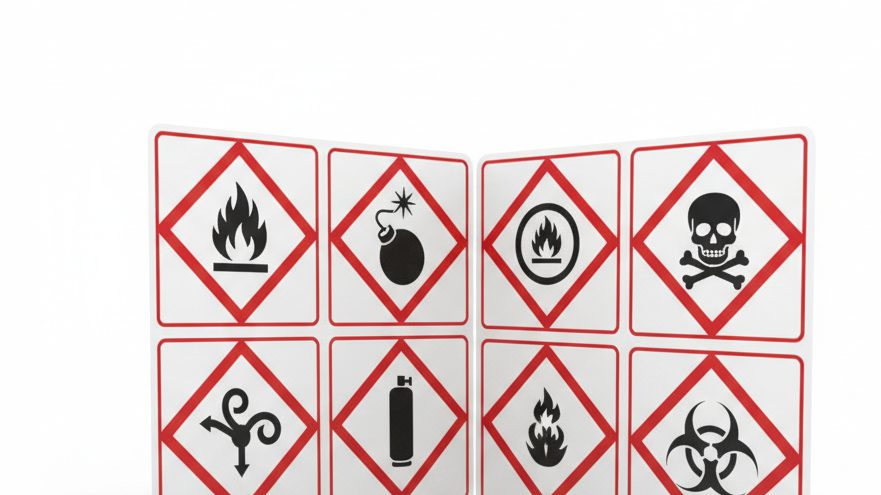
- The applicable hazard pictograms.
- The waste code.
- The date the container was first filled.
- The producer’s name and site.
- Any specific handling warning, such as “do not mix with acid”.
Pictograms follow the Globally Harmonised System, the same red-bordered diamonds used on chemical products [10]. Do not reuse the product label from the original substance. The waste may contain a mixture.
Storage
Storage is where most incidents happen, and the rules are physical rather than administrative.
Contain it. Liquids stand in bunded areas or on spill pallets. The bund holds at least 110% of the largest container, or 25% of the total volume, whichever is greater.
Separate incompatibles. Acids away from alkalis. Oxidisers away from flammables. Cyanides nowhere near acids, because the reaction produces hydrogen cyanide gas.
Keep it covered and secure. Rain fills bunds and washes contaminants away. Unsecured storage invites tampering and theft.
Label the area, not just the drum. A sign at the entrance listing what is stored inside gives the fire service the information it needs before entry.
Limit quantity and time. Waste is not raw material. Storing it indefinitely turns a compliance question into a permitting one.
Watch lithium batteries specifically. They are the fastest-growing fire cause in the waste industry. Store them separately, in non-combustible containers, with terminals taped.
The manifest: proving where it went
The single most important document in hazardous waste is the one that follows the load.
Its purpose is simple. It proves that a set quantity of a named waste left one site. It also proves that it arrived at another site licensed to receive it. If the record breaks, the producer cannot show what happened.
In England, Wales and Northern Ireland this document is the hazardous waste consignment note; in Scotland it is the special waste consignment note. It sits on top of the general duty of care in section 34 of the Environmental Protection Act 1990 [9].
From 1 October 2026, permitted waste receiving sites in England, Wales and Northern Ireland must also log every load on the government Digital Waste Tracking Service [3]. They have two working days to do it. Scotland follows in January 2027. Carriers, brokers and dealers join in October 2027.
Paper is not abolished. Consignment notes and transfer notes remain legally required alongside the digital record during the transition [3].
In the UAE and the Gulf
Federal Law No. 12 of 2018 provides the national framework, applies inside free zones, and excludes nuclear and radioactive waste from its scope [6]. Article 13 deals specifically with hazardous waste, and Article 28 sets fines of up to AED 1,000,000 for unlawful disposal by a private establishment.
In Abu Dhabi, every hazardous movement runs through the Bolisaty electronic manifest system. Producers, transporters and receiving facilities all register, and the manifest links them into a single record [4]. Licensing, vehicle tracking, tariffs and inspection moved from Tadweer Group to the Environment Agency – Abu Dhabi [4]. Licence applications now go to the agency. Landfill access permits stay with Tadweer.
In Dubai, Law No. 18 of 2024 and its 2026 bylaw require a permit for handling hazardous waste, and prohibit mixing [7]. Records are kept for five years for hazardous waste. Non-hazardous records are kept for two years. Dubai Municipality publishes its own approved hazardous waste transporter list. Every regulated collection generates a Waste Transfer Note on the Montaji platform.
What to do first
- List every hazardous waste your site produces, process by process.
- Classify each one. Record the reasoning, not just the code.
- Check the storage area against containment, separation and security.
- Confirm your carrier is licensed for that specific waste.
- Confirm the receiving facility is licensed for it too.
- File manifests by date, and check that the returned copy arrives.
- Never mix streams to reduce the number of collections.
Professional layer — engineering, operations & compliance detail (click to expand)
Professional
Classification methodology
Classification proceeds in a fixed order, and the order matters because it prevents the common error of coding by appearance.
Identify the process. The waste code is assigned by the activity that produced the waste, not by what the waste resembles. The same material from two processes can carry different codes.
Find the candidate entries. In the European List of Waste system a code is six digits. Entries are absolute hazardous, absolute non-hazardous, or mirror entries where a hazardous and a non-hazardous code exist as a pair.
Assess the mirror entry. Where a mirror pair applies, the determination is made by assessing the waste against HP1 to HP15 using the concentration thresholds in Annex III of the Waste Framework Directive [2]. This requires knowing the substances present and their concentrations, which normally means safety data sheets for the inputs, process knowledge, and in contested cases laboratory analysis.
Record the reasoning. A classification without a written justification cannot be defended at inspection. Keep the safety data sheets, the calculation, and the date.
The parallel systems serve different purposes and are not interchangeable. UN numbers and the transport classes govern carriage. The Globally Harmonised System governs labelling. RCRA F, K, P and U listings plus the D characteristic codes govern the United States regime. A single waste can carry codes in all of them simultaneously.
Storage design
Design storage against three failure modes: containment loss, incompatible contact, and ignition.
Containment. Secondary containment sized at 110% of the largest vessel or 25% of aggregate volume. Impermeable base, no drains to surface water, and a means of removing rainwater under control. Where the store is external, roofing is preferable to pumping.
Segregation. Build a compatibility matrix for the actual inventory rather than relying on a generic chart. The reactions that cause serious incidents are predictable: acid plus cyanide produces hydrogen cyanide; acid plus sulphide produces hydrogen sulphide; oxidiser plus organic produces fire; water plus reactive metal produces hydrogen.
Ignition control. Bonding and earthing for flammable liquid transfer, area classification where flammable vapours may accumulate, and separation distances from occupied buildings and boundaries.
For Gulf sites add heat to the design case. Ambient temperatures raise vapour pressure inside drums, accelerate corrosion of container seams, and shorten the safe storage period for reactive materials. Shade structures and ventilation are not optional refinements.
Manifest and record systems compared
| Jurisdiction | Instrument | Retention | Direction of travel |
|---|---|---|---|
| England and Wales | Hazardous waste consignment note | 3 years | Digital Waste Tracking mandatory for receiving sites from 1 Oct 2026 [3] |
| Abu Dhabi | Bolisaty electronic manifest | Per permit conditions | Licensing and inspection moved to Environment Agency – Abu Dhabi [4] |
| Dubai | Waste Transfer Note via Montaji | 5 years for hazardous waste [7] | Permit-based under Law 18/2024 and the 2026 bylaw |
Three practical consequences follow for a multi-site operator in the region.
First, the data fields are broadly the same everywhere: producer, waste description and code, quantity, carrier, vehicle, destination, and dates. Build one internal record that satisfies all of them and map it outward, rather than maintaining three parallel systems.
Second, the returned copy is the evidence. A consignment note issued but never returned proves nothing. Track outstanding returns as an open item, weekly.
Third, verify the receiving facility’s permit covers the specific waste code, not simply “hazardous waste”. This is the most common gap found in audits.
Transboundary movement
The Basel Convention controls the export and import of hazardous waste through prior informed consent: the exporting state notifies, and the importing and transit states consent in writing before movement [8]. Movement to a state that has banned import is prohibited, and movement without consent is illegal traffic.
For practitioners the operational points are the notification lead time, which is measured in weeks not days, the financial guarantee requirement, and the duty to take the waste back if the movement cannot be completed as intended.
Cost structure
Hazardous disposal cost is driven by treatment route rather than by tonnage alone. Incineration with energy recovery, physico-chemical treatment, stabilisation and secure landfill sit at very different price points, and the classification determines which routes are legally available.
That creates a legitimate and substantial saving: reclassification through segregation. A non-hazardous stream contaminated by a small hazardous fraction is charged entirely at the hazardous rate. In Dubai the gradient is AED 550 per tonne against AED 100 per tonne [5]. Keeping one drum of solvent out of a general skip is worth more than most efficiency projects.
Practitioner notes
Empty containers are the most commonly misclassified item on any site. A drum that held a hazardous substance retains residue and is normally hazardous waste unless it has been cleaned to a defined standard and that cleaning is documented.
Laboratory small packs accumulate unnoticed. Run an inventory annually and dispose of unknowns through an analysis-and-pack service rather than guessing at a code.
Where a site holds legacy material with no records, do not open, mix or move it before identification. Unknown old peroxides and picric acid are the two that injure people.
Common questions
How do I know if my waste is hazardous? Assess it against the hazard properties, using the composition of the material and the process that produced it. Where a mirror entry applies, the concentration thresholds in Annex III of the Waste Framework Directive decide it [2].
Is an empty paint tin hazardous waste? Usually yes. Residue in the container carries the hazard. Containers are only non-hazardous once cleaned to a documented standard.
What happens if the consignment note never comes back? You cannot demonstrate lawful disposal. Chase the return, and record the chase. In the UK, the receiving site’s duty to record digitally from 1 October 2026 makes gaps easier for the regulator to see [3].
Who is liable if a contractor disposes of hazardous waste illegally? The producer’s duty does not end at the gate. In the UK the section 34 duty of care applies. In the UAE, using an unlicensed contractor exposes the producer under the federal law and the emirate-level permit regimes [6][7].
Can hazardous waste be stored on site indefinitely? No. Extended storage moves the site from producer to waste operator and triggers permitting. Check the threshold that applies in your jurisdiction before accumulating.
How much does hazardous disposal cost in the UAE? Dubai Municipality’s 2026 gate fee for hazardous and special waste is AED 550 per tonne, before collection and handling charges [5]. Specialist streams such as medical waste are priced separately.
References
Show all 10 sources
- Department for Environment, Food and Rural Affairs (2025) UK statistics on waste, hazardous waste generation and treatment datasets (England 2022; UK 2020). GOV.UK. Available at: https://www.gov.uk/government/statistics/uk-waste-data/uk-statistics-on-waste (Accessed: 25 August 2026).
- European Union (2008) Directive 2008/98/EC on waste (Waste Framework Directive), consolidated text, Art. 7 and Annex III (hazard properties HP1 to HP15). Available at: http://data.europa.eu/eli/dir/2008/98/oj (Accessed: 25 August 2026).
- Department for Environment, Food and Rural Affairs and Environment Agency (2026) Digital waste tracking service. Mandatory for permitted waste receiving sites in England, Wales and Northern Ireland from 1 October 2026; Scotland January 2027; carriers, brokers and dealers October 2027. Legal basis s.58 Environment Act 2021. Available at: https://www.gov.uk/guidance/digital-waste-tracking (Accessed: 25 August 2026).
- Environment Agency – Abu Dhabi (2024) EAD expands licensing and permitting services to include waste licensing and inspection management activities. Transfer of waste licensing, vehicle tracking, tariff and inspection functions from Tadweer Group; Bolisaty electronic manifest. Available at: https://www.ead.gov.ae/ (Accessed: 25 August 2026).
- Dubai Municipality (2026) Waste disposal gate fee schedule 2026. Hazardous and special waste AED 550/t; general and organic waste AED 100/t. Confirm current rates with Dubai Municipality before commercial reliance.
- United Arab Emirates (2018) Federal Law No. 12 of 2018 on Integrated Waste Management, Arts. 3, 13 and 28. UAE Legislation Portal. Available at: https://uaelegislation.gov.ae/en (Accessed: 25 August 2026). The Arabic text is the legal instrument.
- Government of Dubai (2024) Law No. (18) of 2024 Regulating Waste Management in the Emirate of Dubai, Arts. 8, 9 and 10, and Administrative Resolution No. (34) of 2026. Dubai Legislation Portal. Available at: https://dlp.dubai.gov.ae/en (Accessed: 25 August 2026). The Arabic text is the legal instrument.
- United Nations Environment Programme (1989) Basel Convention on the Control of Transboundary Movements of Hazardous Wastes and their Disposal. Available at: https://www.basel.int/ (Accessed: 25 August 2026).
- United Kingdom (1990) Environmental Protection Act 1990, s.34 (duty of care). Available at: https://www.legislation.gov.uk/ukpga/1990/43 (Accessed: 25 August 2026).
- United Nations (2023) Globally Harmonized System of Classification and Labelling of Chemicals (GHS), tenth revised edition. UNECE. Available at: https://unece.org/transport/dangerous-goods/ghs-rev10-2023 (Accessed: 25 August 2026).
Related articles
Start here – What Is Waste Management?
Related – Hazardous Waste Classification Systems – Medical & Healthcare Waste – Electronic Waste (WEEE) – Oil & Gas Industry Waste
Go deeper – Commercial & Industrial Waste (C&I) – Waste Management in the Gulf Context – The Waste Hierarchy – Segregation at Source
About this article
Charmaine Frost is a landfill gas and waste-management specialist and a founding director of Qualifrost FZC LLC. Her experience was gained with major UK waste-management companies, covering landfill gas generation and collection systems, environmental monitoring and the practical risks of landfill operations. She holds the NEBOSH International General Certificate and has submitted her final NEBOSH Diploma assessment, with results expected in March–April 2027.
Reviewed by Adrian Frost, Director. Every article is checked against primary sources before publication: legal claims are verified against the instrument itself, and figures against the original dataset.
Published 25 August 2026 · Last reviewed 25 August 2026 · Next review August 2027, or sooner if the law changes.