

Segregation at Source: Bin Systems, Colour Coding and Community Engagement
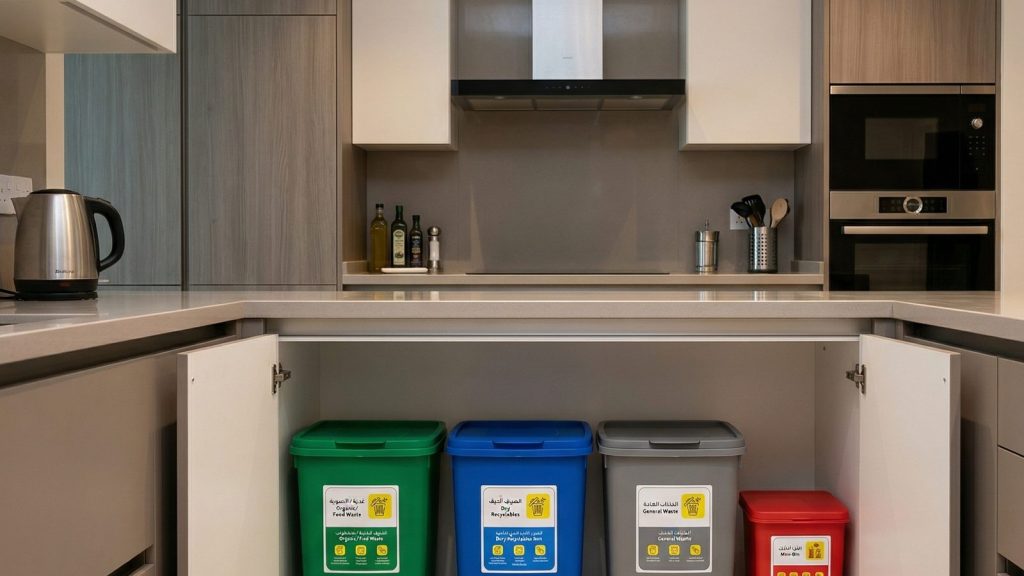
In short
Segregation at source means separating waste into different streams at the point it is produced, rather than mixing it and sorting later. It matters because material separated cleanly at source is worth more and can be recycled into higher-grade products, while material recovered from mixed waste is contaminated and often only suitable for low-value uses. The federal framework is set by Federal Law No. 12 of 2018 on Integrated Waste Management and its Executive Regulation, Cabinet Resolution No. 39 of 2021. Dubai Municipality runs its own collection schemes, and bin colours are not always consistent between schemes, so the same colour may not mean the same stream everywhere. Successful schemes depend less on the bins themselves than on clear instruction, convenience and consistent collection.
Key facts
- Bin colour codes in the UAE are not always consistent between federal guidance and Dubai Municipality schemes. Check the label on each bin and verify colours against current guidance
- Cabinet Resolution No. 39 of 2021 is the Executive Regulation of Federal Law No. 12 of 2018 on Integrated Waste Management. Verify any colour-coding and e-waste or battery take-back obligations, and who bears them, against the instrument text [1]
- EU law requires separate collection of paper, metal, plastic and glass, with bio-waste separated or recycled at source since 31 December 2023 [2]
- Organic waste is about 40% of UAE municipal waste — the largest single segregation opportunity [3]
- In the EU, about 50% of household-generated waste still ends up in the mixed bin [4]
- Dubai charges AED 100 per tonne for general waste; a contaminated recyclable load is reclassified to that rate [5]
- Dubai waste legislation is reported to allow the Municipality to require producers to implement segregation. Verify the law number and article against the Dubai Legislation Portal [6]
Plain English — the essentials, in everyday language
Plain English
Why separate at all?
Material separated cleanly at source is worth money. Material pulled out of mixed rubbish usually is not.
That single sentence explains the whole subject. Paper mixed with food waste absorbs moisture and grease, and can no longer be made into good paper. Glass broken among general waste contaminates other materials with fragments. Once streams are mixed, some of the value is gone permanently.
Sorting facilities can recover material from mixed waste, but the output is lower grade and worth less.
The two codes in the UAE
This confuses residents, and it is not their fault. Colour schemes are not always consistent between federal guidance and local schemes.
| Colour | Federal scheme (verify against [1]) | Dubai Municipality (verify against current DM guidance) |
|---|---|---|
| Green | Recyclables | Verify with DM |
| Black | General waste | Verify with DM |
| Brown | Organic | Verify with DM |
| Yellow | — | Verify with DM |
| Red | Hazardous | Verify with DM |
The same colour may not mean the same stream in every scheme. Read the label on the bin rather than trusting the colour.
What makes a scheme work
Research and practical experience point to the same four things:
1. Convenience. If the recycling bin is further away than the general bin, most people use the general bin. Distance beats intention.
2. Clear instruction with pictures. Text alone fails in a country where residents speak many languages. Pictograms work across all of them.
3. Feedback. People who are told what happened to their recycling keep doing it. People who suspect it all goes to landfill stop.
4. Consistent collection. If the separated bins are emptied into the same truck, the scheme dies within weeks. Nothing destroys participation faster.
What contaminates a load
- Food residue in containers
- Plastic bags containing recyclables, which jam sorting machinery
- Nappies and sanitary waste
- Textiles and hoses, which wrap around rotating equipment
- Batteries, which cause fires
- Broken glass mixed with paper
Batteries deserve emphasis. Lithium-ion cells crushed in a truck or at a sorting facility start fires. Use designated battery and e-waste collection points rather than household bins, and verify any take-back obligations against the instrument text [1].
In the UAE and the Gulf
Apartment living shapes everything. Most UAE residents live in apartment buildings with shared containers. Nobody is individually accountable for a shared bin, so contamination rates run higher than in villa districts with individual bins.
Language matters more across the GCC than almost anywhere. A large share of residents speak Arabic, Hindi, Urdu, Tagalog, Malayalam or Bengali as a first language. Signage needs pictograms as the primary instruction, with text as support.
Heat compresses the timetable. Separated food waste becomes unpleasant within a day at 45°C. Organic collections need to be frequent, and containers need tight lids.
The regulator can compel it. Dubai waste legislation is reported to give the Municipality power to require producers to implement segregation, sorting and recycling. Verify the law number and article against the Dubai Legislation Portal [6].
Contamination has a price. A clean recyclable load can be collected at nil cost in Dubai. Contaminated, it becomes general waste at AED 100 per tonne [5].
Practical steps at home
- Rinse containers quickly. They do not need to be spotless, just free of food
- Never bag recyclables unless your scheme says to
- Keep a small container for food waste and empty it daily in summer
- Take batteries and old electronics to a designated collection or take-back point [1]
- Flatten cardboard. It saves space and speeds collection
Professional layer — engineering, operations & compliance detail (click to expand)
Professional
Scheme design parameters
| Factor | Villa / low density | Apartment / high density |
|---|---|---|
| Container type | Individual wheeled bins | Shared communal containers |
| Accountability | Visible, individual | Diffuse — main contamination driver |
| Typical contamination | Lower | Higher without intervention |
| Intervention that works | Feedback tags on bins | Concierge or building champion model |
| Collection frequency | Weekly viable for dry | Organic needs 2–3 times weekly in summer |
Design around the housing stock, not around a national target. A scheme that works in Al Ain villas will not transfer unchanged to a Dubai Marina tower.
The number of streams question
More streams give cleaner material but lower participation. The practical sequence for a maturing system:
- Dry recyclables plus residual — simplest, highest participation, immediate gain
- Add organics — highest climate value, hardest operationally in hot climates
- Split dry recyclables — paper from containers, where reprocessing markets justify it
- Add specialist streams — textiles, WEEE, batteries via bring banks and take-back
Attempting step 3 before step 1 is embedded produces contamination in every stream at once.
Measuring performance
Three metrics, all needed:
- Capture rate — proportion of a target material actually placed in the correct bin. The honest measure of scheme performance
- Contamination rate — proportion of the wrong material in a separated stream. Determines whether output is saleable
- Participation rate — proportion of households taking part at all
A high recycling tonnage with a 30% contamination rate is a worse outcome than a lower tonnage at 5%, because the reprocessor discounts or rejects the load.
Measure by physical composition analysis to ASTM D5231-92(2024) [7], not by visual estimate at the kerbside.
Regulatory position
UAE federal. Cabinet Resolution No. 39 of 2021 is the Executive Regulation of Federal Law No. 12 of 2018 on Integrated Waste Management. Verify any colour-coding requirements and e-waste or battery take-back obligations (who bears them and for which products) against the instrument text, citing the specific articles [1].
Dubai. Dubai waste legislation is reported to permit the Municipality to require producers to implement segregation, sorting and recycling, and to require establishments to accept waste-derived materials as feedstock. It is also reported to require large generators to hold a DM-approved waste management plan. Verify the law number, year and article references (cited as Law No. 18 of 2024, Arts. 8(4) and 16) against the Dubai Legislation Portal [6].
EU benchmark. The Waste Framework Directive requires separate collection of paper, metal, plastic and glass, with bio-waste separated or recycled at source from 31 December 2023, and textiles and household hazardous waste from 1 January 2025 [2].
Note the scale of the underlying challenge even in mature systems: roughly half of household-generated waste in the EU still reaches the mixed bin [4].
Practitioner notes
- Harmonise colour before scaling communication. Spending on awareness while inconsistent codes operate embeds confusion rather than resolving it
- Audit at the tipping face, not at the bin. Contamination visible in a container understates what arrives at the facility
- Building-level champions outperform mass campaigns in high-rise stock. One informed resident per building changes behaviour more than a city-wide poster campaign
- Benchmark against global capture data, not local anecdote. UNEP’s Global Waste Management Outlook provides the comparative baseline [8], and WRAP’s work on consistency of messaging is the best available evidence on what changes household behaviour [9]
- Never mix separated streams in one vehicle, even once. Participation collapses on first sighting and takes far longer to rebuild than it took to lose
Common questions
What does segregation at source mean? Separating waste into different containers at the point it is produced — in the kitchen, the office or the site — instead of mixing everything and trying to sort it later.
Why are UAE bin colours different in Dubai? Federal guidance and Dubai Municipality schemes do not always use the same colours, and schemes change over time. Check current Dubai Municipality guidance. Read the label on the bin.
Does it matter if I put one wrong item in? One item rarely matters. Systematic contamination does. Food residue, plastic bags and batteries cause the most damage, and a heavily contaminated load can be rejected outright.
Should I wash containers before recycling? Rinse them. They do not need to be spotless, but food residue attracts pests, smells in heat, and degrades paper and card in the same load.
Can the authorities force businesses to segregate? In Dubai, the waste legislation is reported to allow the Municipality to require producers to implement segregation, sorting and recycling. Verify the current law and article against the Dubai Legislation Portal [6].
References
Show all 9 sources
- UAE Cabinet (2021) Cabinet Resolution No. 39 of 2021 on the Executive Regulation of Federal Law No. 12 of 2018 on Integrated Waste Management. UAE Legislation Portal. Available at: https://uaelegislation.gov.ae/en (Accessed: 25 August 2026).
- European Union (2008) Directive 2008/98/EC on waste (Waste Framework Directive), Arts. 11 and 22. Available at: http://data.europa.eu/eli/dir/2008/98/oj (Accessed: 25 August 2026).
- Fast Company Middle East (2026) UAE’s circular economy goals hinge on stronger organic waste management. Organic waste at nearly 40% of UAE municipal waste. Available at: https://fastcompanyme.com/news/uaes-circular-economy-goals-hinge-on-stronger-organic-waste-management/ (Accessed: 25 August 2026).
- European Commission Joint Research Centre (2025) Comprehensive assessment of environmental and economic impacts of the entire EU waste management system. JRC141204. Reports approximately 50% of household-generated waste reaching mixed waste. Available at: https://publications.jrc.ec.europa.eu/repository/handle/JRC141204 (Accessed: 25 August 2026).
- Dubai Municipality (2026) Waste disposal gate fee schedule 2026. General and organic waste AED 100/t. Confirm current rates with Dubai Municipality before commercial reliance.
- Government of Dubai (2024) Law No. (18) of 2024 Regulating Waste Management in the Emirate of Dubai, Arts. 8 and 16 (law number, year, title and article references to be verified against the official text). Dubai Legislation Portal. Available at: https://dlp.dubai.gov.ae/en (Accessed: 25 August 2026). Arabic text prevails.
- ASTM International (2024) ASTM D5231-92(2024) Standard Test Method for Determination of the Composition of Unprocessed Municipal Solid Waste. Available at: https://www.astm.org/d5231-92r24.html (Accessed: 25 August 2026).
- UNEP and ISWA (2024) Global Waste Management Outlook 2024. Available at: https://www.unep.org/resources/global-waste-management-outlook-2024 (Accessed: 25 August 2026).
- WRAP (2026) Recycling collection guidance and consistency of messaging. Available at: https://www.wrap.ngo/ (Accessed: 25 August 2026).
Related articles
Start here – Waste Collection Systems
Related – Municipal Solid Waste (MSW) – Transfer Stations – Smart Waste Solutions – Food Waste
Go deeper – Material Recovery Facilities (MRF) – Plastics Recycling – Waste Reduction Tips (Households) – Composting
About this article
Charmaine Frost is a landfill gas and waste-management specialist and a founding director of Qualifrost FZC LLC. Her experience was gained with major UK waste-management companies, covering landfill gas generation and collection systems, environmental monitoring and the practical risks of landfill operations. She holds the NEBOSH International General Certificate and has submitted her final NEBOSH Diploma assessment, with results expected in March–April 2027.
Reviewed by Adrian Frost, Director. Every article is checked against primary sources before publication: legal claims are verified against the instrument itself, and figures against the original dataset.
Published 25 August 2026 · Last reviewed 25 August 2026 · Next review August 2027, or sooner if the law changes.