

Medical & Healthcare Waste: WHO Categories, Colour Coding and Treatment
In short
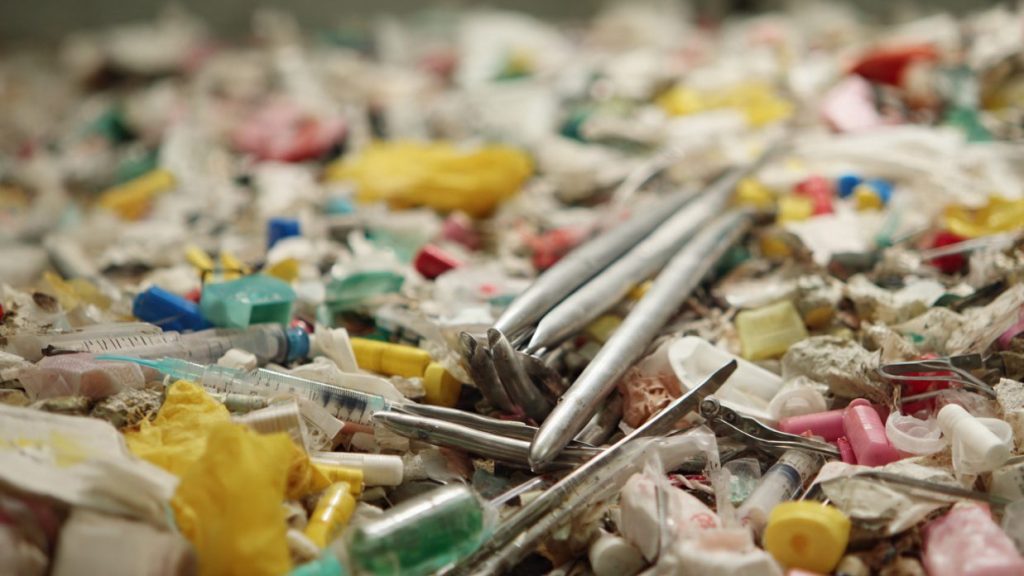
Healthcare waste is everything discarded by hospitals, clinics, laboratories, dental and veterinary practices. About 85% of it is ordinary waste, no more dangerous than office or kitchen rubbish. The remaining 15% is hazardous: infectious material, sharps, pathological waste, pharmaceuticals, chemicals and a very small radioactive fraction. Segregation at the point of generation is what keeps that ratio. Mix the two and the whole load becomes hazardous, which multiplies both the risk and the cost. Sharps carry the highest disease-transmission risk of any waste category.
- 1SegregateAt the point of generation, using colour-coded containers
- 2Contain and labelSharps in rigid containers; bags tied and tagged
- 3Internal transportDedicated trolleys and secure storage
- 4Licensed collectionAuthorised carrier with documentation
- 5TreatmentAutoclave or incineration according to waste type
- 6RecordsConsignment records retained
Key facts
- About 85% of healthcare waste is general, non-hazardous waste; the remaining 15% is hazardous, and may be infectious, toxic or radioactive [1]
- An estimated 16 billion injections are administered worldwide each year, and not all needles and syringes are disposed of safely [1]
- With good segregation, hospitals generate 2 to 4 kg of waste per bed per day, of which only 0.2 to 0.4 kg is infectious [2]
- Sharps waste carries the highest risk of disease transmission of all healthcare waste categories [2]
- Dubai’s official medical waste treatment fee for private-sector generators is AED 6 per kilogram, set by Executive Council Resolution No. 58 of 2017 [3]
- In Abu Dhabi, the Department of Health requires infectious laboratory waste to be autoclaved within 24 hours and re-bagged before final disposal [4]
- Medical waste in Dubai requires a contractor approved by both Dubai Municipality and the Dubai Health Authority [5]
Plain English — the essentials, in everyday language
Plain English
The 85/15 rule
Most hospital waste is not dangerous.
The World Health Organization puts the split at roughly 85% general and 15% hazardous [1]. The general fraction comes from offices, kitchens, packaging and building maintenance. It is no more risky than household waste.
The 15% is the part that needs control. It divides into six kinds.
The six hazardous categories
Sharps. Needles, scalpels, lancets, broken glass, ampoules. This is the highest-risk category, because a single puncture can transmit disease [2].
Infectious waste. Anything contaminated with blood or body fluids. Dressings, swabs, gloves, gowns, tubing, laboratory cultures.
Pathological waste. Human tissue, organs, body parts, and contaminated animal carcasses.
Pharmaceutical waste. Expired, unused or contaminated medicines and vaccines. Cytotoxic and cytostatic drugs used in cancer therapy are handled separately, because they are genotoxic.
Chemical waste. Laboratory reagents, disinfectants, solvents, film developer, and mercury from broken thermometers and blood-pressure gauges.
Radioactive waste. Unused radiotherapy and laboratory liquids, and items contaminated by them. Very small by weight.
Colour coding
Colour coding exists so that a decision made in a treatment room by a busy clinician cannot be undone later. There is no single global scheme, so always follow the local one.
The scheme used across the United Kingdom, set out in HTM 07-01, is the most widely copied. Verify container specifications against the current edition before relying on this summary.
| Colour | Contents | Route |
|---|---|---|
| Yellow bag | Infectious waste requiring incineration | Incineration |
| Orange bag | Infectious waste suitable for alternative treatment | Autoclave, then disposal |
| Purple bag | Cytotoxic and cytostatic waste | Incineration only |
| Yellow container with red lid | Anatomical waste | Incineration |
| Sharps bin (yellow, orange or purple lid) | Sharps. The lid colour shows the contamination: yellow for sharps contaminated with medicines, orange for sharps not contaminated with medicines, purple for sharps contaminated with cytotoxic or cytostatic medicines | Yellow and purple lids: incineration. Orange lid: alternative treatment permitted. Verify against HTM 07-01 |
| White container | Dental amalgam | Mercury recovery |
| Black bag | General waste | Ordinary municipal route |
The Department of Health in Abu Dhabi uses a different convention for laboratory infectious waste: blue transparent autoclavable bags before treatment, re-bagged in red after sterilisation [4].
Do not assume the colours used in one country apply in another. Check the local standard before printing signage or training staff.
How each type is treated
Autoclaving. Steam under pressure kills pathogens. It is the standard route for infectious waste and laboratory cultures, and it is cheaper and cleaner than burning. The treated waste is usually shredded to make it unrecognisable, then disposed of as ordinary waste.
High-temperature incineration. Required for anatomical waste, cytotoxic drugs and most pharmaceuticals. It destroys the material completely. It needs proper emission control.
Microwave and chemical disinfection. Alternatives to autoclaving for specific streams, sometimes installed on site at larger hospitals.
Sharps. Rigid, puncture-resistant containers, filled to no more than the marked line, then treated as infectious waste. Never decant a sharps bin.
Mercury and amalgam. Separated for recovery. Never incinerated.
Why segregation is the whole game
Mixing turns 85% general waste into 100% hazardous waste.
One infectious bag dropped into a general bin contaminates the whole container. The disposal cost of that load rises to the hazardous rate, and the handling risk rises with it. Clinical waste costs a great deal more per tonne to dispose of than general waste.
That is why the bin has to be within arm’s reach of the person generating the waste. Segregation fails on layout far more often than on training.
In the UAE and the Gulf
Medical waste in the UAE is regulated by health authorities and waste authorities together, and you need approval from both.
In Dubai, a medical waste contractor must hold approval from Dubai Municipality and from the Dubai Health Authority [5]. Waste is stored in colour-coded, UN-approved containers with biohazard labelling. Treatment is by high-temperature incineration or autoclave sterilisation at a licensed facility. Every collection generates a Waste Transfer Note on the Montaji platform under Law No. 18 of 2024 [6].
Dubai’s official treatment fee at a municipal facility is AED 6 per kilogram for private-sector generators, set by Executive Council Resolution No. 58 of 2017 [3]. That is the government rate at the treatment plant, not the full cost of the service.
In Abu Dhabi, the Department of Health sets the medical waste management standard for licensed healthcare facilities [4]. It requires designated storage rooms, bins emptied before they reach their fill line, autoclave cycles verified with chemical indicators every run and biological indicators at least weekly, and treated waste rendered unrecognisable before final disposal.
Federal Law No. 12 of 2018 sits above both, and Article 13 covers hazardous waste generally [7].
What a clinic should do
- Put the right bin in every room where waste is generated
- Never fill a sharps bin past the marked line
- Train every new starter before their first shift, not after
- Keep the storage room locked, cool and signed
- Check that your contractor holds both health and municipal approvals
- Keep the transfer notes, and check the returned copy arrives
- Audit the bins quarterly by looking inside them
Professional layer — engineering, operations & compliance detail (click to expand)
Professional
Classification and the coding gap
The WHO classification and the regulatory waste codes do not map cleanly onto each other, and this is a persistent source of reporting error.
WHO defines two headline categories with six hazardous sub-categories [1], and its 2014 handbook remains the operational reference for facility-level systems [8]. The European system codes healthcare waste under chapter 18 of the List of Waste, splitting human healthcare (18 01) from animal healthcare (18 02), with mirror entries that turn on whether infection risk is present [9]. Under that system, 18 01 03* covers wastes whose collection and disposal is subject to special requirements in order to prevent infection, while 18 01 04 covers wastes whose collection and disposal is not subject to special requirements in order to prevent infection (e.g. dressings, plaster casts, linen, disposable clothing, diapers).
The consequence is that a facility can report a very low infectious percentage under the coding system while WHO-style benchmarking suggests a higher one. When comparing sites, confirm which classification is being used before drawing a conclusion.
Generation rates for design
Design figures matter because storage, collection frequency and treatment capacity all follow from them.
With good segregation, hospital total waste runs at 2 to 4 kg per bed per day, of which infectious waste is 0.2 to 0.4 kg per bed per day [2]. Bulk density for healthcare waste is typically 100 to 200 kg per cubic metre [2]. Use volume, not mass, to size storage rooms and container fleets, because healthcare waste is light and bulky.
Where segregation is poor, the infectious fraction can rise several-fold. That is a management signal, not a design input. Do not build capacity around a broken system.
Storage requirements
Healthcare waste storage design has four controls.
Temperature. Infectious and pathological waste degrades and becomes odorous. Refrigerated or air-conditioned storage is required where holding time exceeds the local limit. The Abu Dhabi standard for laboratory infectious waste specifies a maximum air temperature and disposal within 24 hours [4].
Time. Set a maximum holding period and enforce it with a dated label on every container. In Gulf ambient conditions, holding times must be shorter than temperate-climate guidance suggests.
Access. Lockable, signed, restricted to trained staff, and separated from clean supply and food routes.
Containment. Impermeable washable surfaces, drainage to foul sewer where permitted, and spill kit at the door.
Treatment technology selection
| Technology | Suitable for | Not suitable for | Notes |
|---|---|---|---|
| Autoclave | Infectious waste, cultures, sharps | Cytotoxics, pharmaceuticals, anatomical waste | Validate with chemical indicators every cycle, biological indicators weekly [4] |
| High-temperature incineration | Anatomical, cytotoxic, pharmaceutical | Mercury, radioactive | Requires flue gas treatment |
| Microwave | Infectious waste | Anatomical, chemical | Needs consistent load moisture |
| Chemical disinfection | Liquids, some solids | Anatomical | Generates a chemical effluent |
Autoclave validation is the point most commonly failed at audit. Installation qualification, operational qualification and performance qualification should be documented, with cycle records retained and indicator results filed against each run [4].
Double-door pass-through autoclaves are preferred, because they enforce unidirectional flow from the contaminated side to the clean side [4].
Reducing the hazardous fraction
The single largest cost lever is moving material out of the 15% and back into the 85%, without compromising safety.
Practical measures, in order of return:
- Bin placement. Put the general bin next to the clinical bin, everywhere. If the only bin in reach is orange, everything goes in orange.
- Glove policy. Uncontaminated gloves and packaging are general waste. This is often the biggest single misplaced fraction.
- Room-level audit. Weigh and inspect by department. The variation between wards in the same hospital is usually larger than the variation between hospitals.
- Reusable sharps containers where the local regime permits them, with validated washing.
- Pharmaceutical stock control. Expired medicine is a purchasing failure before it is a waste problem.
Occupational exposure
Sharps injuries remain the dominant occupational risk. The controls that work are engineering controls first: safety-engineered devices with retracting or shielded needles, sharps containers mounted at the point of use, and a strict no-recapping rule.
Post-exposure procedure must be written, posted and rehearsed. The window for post-exposure prophylaxis is short, and a procedure that requires someone to find a policy document has already failed.
Practitioner notes
Check what happens to waste at night and at weekends. Segregation discipline routinely collapses outside core hours when the cleaning contractor takes over.
Verify the treatment destination, not just the collection. Ask for the receiving facility’s licence and the treatment method for each stream you produce.
Watch pharmaceutical returns. Community pharmacies and clinics accumulate returned medicine without a defined route, and the stock sits for years.
Common questions
How much healthcare waste is actually hazardous? About 15%, when segregation is done properly [1]. Where it is not, the measured hazardous fraction rises sharply, but that reflects contamination rather than genuine risk.
Can infectious waste be autoclaved instead of burned? Yes, for most infectious waste and laboratory cultures. Anatomical waste, cytotoxic drugs and most pharmaceuticals still require high-temperature incineration.
What goes in a sharps bin? Anything that can pierce skin: needles, scalpel blades, lancets, ampoules, broken glass. Fill only to the marked line and never decant.
Who approves a medical waste contractor in Dubai? Both Dubai Municipality and the Dubai Health Authority. A single approval is not sufficient [5].
What does medical waste treatment cost in Dubai? Executive Council Resolution No. 58 of 2017 sets AED 6 per kilogram for private-sector generators at a municipal treatment facility [3]. Collection, containers and documentation are additional.
Is a used but uncontaminated glove clinical waste? Not automatically. Gloves without contamination from blood or body fluids are general waste in most schemes. Local policy governs, and it should be written down.
References
Show all 9 sources
- World Health Organization (2024) Health-care waste, fact sheet. About 85% general and 15% hazardous; approximately 16 billion injections administered annually. Available at: https://www.who.int/news-room/fact-sheets/detail/health-care-waste (Accessed: 25 August 2026).
- World Health Organization (2019) Training modules in health-care waste management, Module 9: Classification of health-care waste. Generation rates 2 to 4 kg per bed per day; infectious 0.2 to 0.4 kg per bed per day; bulk density 100 to 200 kg/m³; sharps highest transmission risk. Available at: https://cdn.who.int/media/docs/default-source/wash-documents/wash-in-hcf/ (Accessed: 25 August 2026).
- Government of Dubai (2017) Executive Council Resolution No. 58 of 2017 on waste disposal fees, medical waste treatment fee AED 6 per kilogram for private-sector generators. Dubai Legislation Portal. Available at: https://dlp.dubai.gov.ae/en (Accessed: 25 August 2026). The Arabic text is the legal instrument.
- Department of Health – Abu Dhabi (2025) Standard for Medical Waste Management. Storage, colour coding, autoclave qualification and validation, 24-hour treatment of infectious laboratory waste, post-treatment handling. Available at: https://www.doh.gov.ae/ (Accessed: 25 August 2026).
- Dubai Municipality and Dubai Health Authority (2026) Medical and clinical waste requirements, Emirate of Dubai. Dual approval, UN-approved containers, incineration or autoclave treatment at licensed facilities. Available at: https://www.dm.gov.ae/ (Accessed: 25 August 2026).
- Government of Dubai (2024) Law No. (18) of 2024 Regulating Waste Management in the Emirate of Dubai, and Administrative Resolution No. (34) of 2026. Dubai Legislation Portal. Available at: https://dlp.dubai.gov.ae/en (Accessed: 25 August 2026). The Arabic text is the legal instrument.
- United Arab Emirates (2018) Federal Law No. 12 of 2018 on Integrated Waste Management, Article 13 (hazardous waste). UAE Legislation Portal. Available at: https://uaelegislation.gov.ae/en (Accessed: 25 August 2026). The Arabic text is the legal instrument.
- World Health Organization (2014) Safe management of wastes from health-care activities, second edition. Geneva: WHO. Available at: https://www.who.int/publications/i/item/9789241548564 (Accessed: 25 August 2026).
- European Union (2008) Directive 2008/98/EC on waste (Waste Framework Directive), consolidated text, and the List of Waste chapter 18 entries for healthcare waste. Available at: http://data.europa.eu/eli/dir/2008/98/oj (Accessed: 25 August 2026).
Related articles
Start here – Hazardous Waste
Related – Municipal Solid Waste (MSW) – Commercial & Industrial Waste (C&I) – Hazardous Waste Classification Systems – Waste Management in the Gulf Context
Go deeper – Segregation at Source – The Waste Hierarchy – What Is Waste Management? – Electronic Waste (WEEE)
About this article
Charmaine Frost is a landfill gas and waste-management specialist and a founding director of Qualifrost FZC LLC. Her experience was gained with major UK waste-management companies, covering landfill gas generation and collection systems, environmental monitoring and the practical risks of landfill operations. She holds the NEBOSH International General Certificate and has submitted her final NEBOSH Diploma assessment, with results expected in March–April 2027.
Reviewed by Adrian Frost, Director. Every article is checked against primary sources before publication: legal claims are verified against the instrument itself, and figures against the original dataset.
Published 25 August 2026 · Last reviewed 25 August 2026 · Next review August 2027, or sooner if the law changes.