

Sharjah, Ajman & Northern Emirates Waste Regulation: EPAA, Bee’ah, Ajman Municipality and RAK/Fujairah
In short: Across Sharjah, Ajman, Ras Al Khaimah, Fujairah, and Umm Al Quwain, Federal Law No. (12) of 2018 and Cabinet Resolution No. (39) of 2021 provide the statutory baseline, while local municipalities and environmental authorities govern collection, permitting, and treatment infrastructure. Sharjah leads regional diversion (~90%+) through BEEAH Group’s Al Saja’a integrated complex and the Sharjah Waste-to-Energy plant.
Key facts
- Sharjah’s Al Saja’a Waste Management Complex (operated by BEEAH Group) achieves ~90% landfill diversion across MSW and C&D streams [1].
- The Sharjah Waste-to-Energy facility (Emirates Waste to Energy, BEEAH/Masdar) processes 300,000 tonnes/year to generate 30 MWe [1].
- Ajman Municipality & Planning Department (AMPD) regulates commercial permits, waste transport, and the Al Jurf / Al Helio waste facilities [2].
- Ras Al Khaimah Waste Management Agency (RAKWMA) and Fujairah Environment Authority enforce source segregation and industrial permitting in the northern emirates [3].
Plain English — the essentials, in everyday language
Plain English
How Sharjah built the region’s highest diversion system
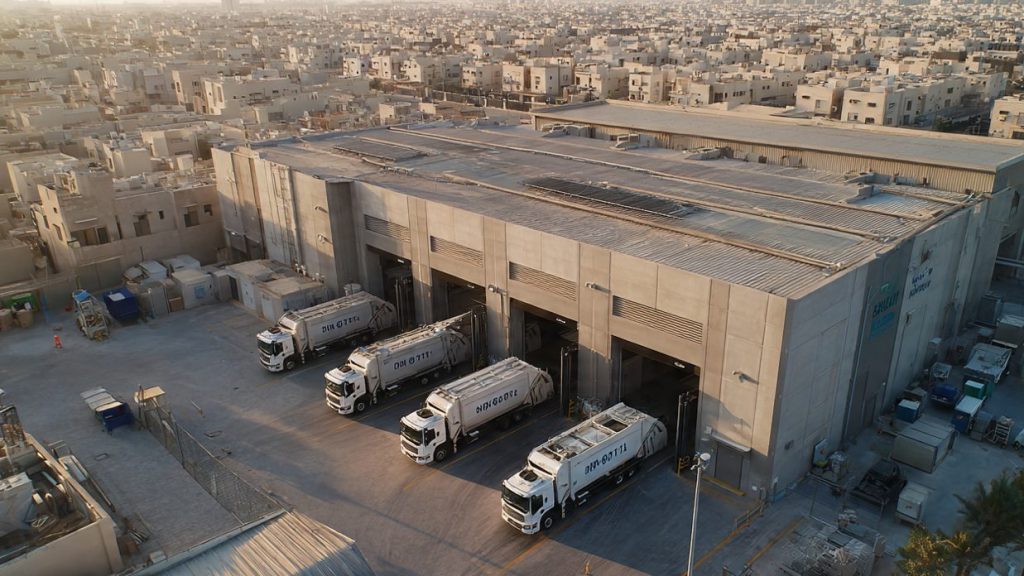
In the Emirate of Sharjah, municipal and commercial waste management is delivered through a public-private partnership with BEEAH Group (formerly Bee’ah), regulated alongside Sharjah City Municipality and the Environment and Protected Areas Authority (EPAA) [1]. At the Al Saja’a integrated hub, incoming waste passes through a high-capacity Material Recovery Facility (MRF), a Construction & Demolition (C&D) recycling plant, a tyre shredding and crumb-rubber plant, and the 300,000 t/yr Sharjah Waste-to-Energy facility, pushing overall landfill diversion to approximately 90%.
Waste regulation in Ajman and Umm Al Quwain
In Ajman, the Ajman Municipality and Planning Department (AMPD) oversees public health, waste collection permits, commercial skip licensing, and industrial waste disposal clearances [2]. Businesses operating in Ajman must obtain an AMPD environmental permit and use approved waste contractors. In Umm Al Quwain, the Municipality and Smart Umm Al Quwain portal manage commercial waste permits alongside federal MOCCAE facilities (including the UAQ RDF plant producing alternative fuel for cement kilns).
Ras Al Khaimah and Fujairah frameworks
In Ras Al Khaimah, the Ras Al Khaimah Waste Management Agency (RAKWMA) and the Environment Protection and Development Authority (EPDA) implement colour-coded bag/bin segregation (Green for recyclables, Brown for food/organics) and regulate industrial and quarry waste [3]. In Fujairah, the Fujairah Environment Authority (FEA) and Fujairah Municipality regulate port, marine, quarry, and municipal waste streams.
Professional layer — engineering, operations & compliance detail (click to expand)
Professional
Inter-Emirate Waste Transport under Federal Law No. 12/2018 and Cabinet Resolution 39/2021
A critical operational rule for contractors working across Sharjah, Ajman, Dubai, and the Northern Emirates is the control of inter-emirate waste movements under Federal Law No. (12) of 2018, its Executive Regulations (Cabinet Resolution No. (39) of 2021) and local emirate rules. Transporting hazardous or regulated waste between emirates generally requires approval from the competent authorities and a valid manifest. Confirm the specific approval requirements, including whether consent is needed from both the originating and receiving emirates, with the relevant authorities and against the official legislative text [3].
Alternative Fuels (RDF) & Cement Kiln Co-Processing in the Northern Emirates
Because Ras Al Khaimah and Fujairah host the UAE’s largest Portland cement clinker kilns, non-recyclable high-calorific commercial and municipal residuals from Umm Al Quwain and the Northern Emirates are processed into Refuse-Derived Fuel (RDF) (typical cement-kiln operator acceptance criteria, e.g. NCV ≥ 15 MJ/kg, chlorine < 1.0%; these are not UAE statutory limits, so verify against the receiving kiln’s specification) to displace imported coal in cement precalciners [3].
Practitioner Checklist for Northern Emirates Operations
1. Confirm municipal trade-licence environmental clearance requirements with AMPD (Ajman), Sharjah Municipality/BEEAH, or RAKWMA/EPDA. 2. Never transport waste across emirate boundaries (e.g., from an Ajman factory to a Dubai or Sharjah facility) without the required competent-authority approvals and manifest documentation. 3. Implement two-stream or three-stream segregation to qualify for lower gate fees at BEEAH and RAKWMA recovery facilities.
Common questions
Can a Dubai-licensed waste haulier collect waste in Sharjah or Ajman?
No. A waste transporter must hold a valid permit from the competent municipality/authority of the specific emirate in which collection takes place, and inter-emirate movement requires approval under Federal Law No. 12 of 2018, its Executive Regulations (Cabinet Resolution No. 39 of 2021) and applicable local rules [3].
Does Sharjah ban single-use plastic bags?
Yes. Both federal Ministerial Resolution No. 380 of 2022 and Sharjah Executive Council rules prohibit single-use plastic shopping bags and mandate multi-use or compliant alternatives [1][3].
References
Show all 3 sources
- BEEAH Group (2025) Integrated Waste Management and Sharjah Waste-to-Energy. BEEAH. Available at: https://beeah.com
- Ajman Municipality and Planning Department (2026) Environment and Public Health Services. AMPD. Available at: https://www.am.gov.ae
- UAE Ministry of Climate Change and Environment (2024) Federal Law No. 12 of 2018 and Integrated Waste Management in the UAE. MOCCAE. Available at: https://www.moccae.gov.ae/en/knowledge/wastes-and-chemicals
About this article
Charmaine Frost is a landfill gas and waste-management specialist and a founding director of Qualifrost FZC LLC, drawing on UK Tier-1 operational and engineering experience with major waste-management companies. She holds the NEBOSH International General Certificate and has submitted her final NEBOSH Diploma assessment, with results expected in March–April 2027.
Reviewed by Adrian Frost, Director. Checked against primary statutory instruments and recognised technical standards.