

Tyre Waste: Stockpile Risks, Crumb Rubber and Tyre-Derived Fuel
In short
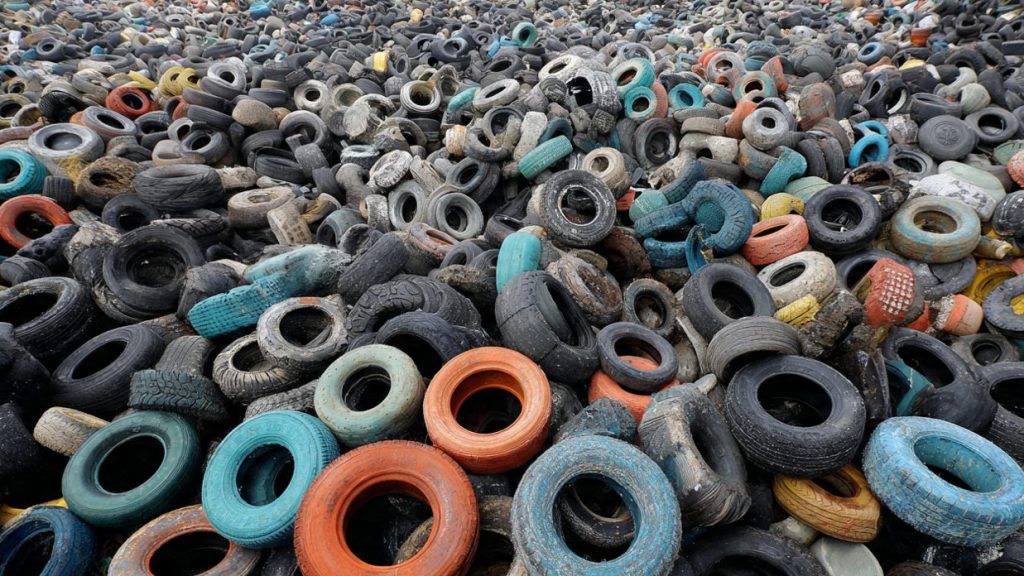
End-of-life tyres are bulky, do not decompose, and burn ferociously once alight. A stockpile fire is one of the hardest fires to extinguish and produces oil and toxic smoke for weeks. The material itself is valuable: tyres have a calorific value of 28 to 38 MJ/kg, comparable to coal, and about 10 to 15% of their weight is recoverable steel. Two routes dominate. Crumb rubber recovers the material for surfaces, asphalt and moulded products. Tyre-derived fuel recovers the energy in cement kilns. Tadweer’s expanded Abu Dhabi facility alone has capacity for 100,000 tonnes a year.
Key facts
- End-of-life tyres have a calorific value of 28 to 38 MJ/kg, comparable to or above bituminous coal at 24 to 35 MJ/kg [1][2]
- Steel is 10 to 15% of tyre weight and is recovered as a saleable by-product [2]
- In the EU including the UK, 51% of end-of-life tyres were recycled as crumb rubber and 42% used for energy recovery in 2021 [3]
- Tadweer’s expanded Abu Dhabi facility has capacity for 100,000 tonnes of used tyres a year, up from 70,000 tonnes [4]
- The Gulf Rubber Factory at Al Ain was built with a minimum capacity of 24,000 tonnes a year (reported figure, to be verified against the primary source), on an investment of AED 50 million [5]
- Rubber can take up to 1,000 years to decompose in landfill because of its high sulphur content [4]
- Crumb rubber production achieves a product mass yield of 0.93 tonnes per tonne of tyre processed, at 74% energy efficiency [3]
Plain English — the essentials, in everyday language
Plain English
Why tyres are a problem
A tyre is engineered not to break down. That is the whole point of it.
Vulcanisation cross-links the rubber so it resists heat, abrasion and weather. It works. A discarded tyre is still a tyre a century later.
Three specific problems follow.
They do not compact. Tyres are mostly air by volume. Buried in a landfill, they trap gas and work their way back up. Most jurisdictions ban them from landfill for that reason.
They breed mosquitoes. A tyre holds a pool of water. It does not evaporate and does not drain. In warm climates a stockpile is a public health issue first. It shelters rodents too.
They burn. That is the serious one.
Tyre fires
A tyre stockpile fire is one of the worst outcomes in waste management.
Once alight, tyres burn hot and burn long. The inside of a pile is starved of oxygen. The rubber pyrolyses instead of burning cleanly. That produces liquid oil, which runs out of the pile into the ground and watercourses.
Water does not put it out. It cools the surface while the interior continues. Large stockpile fires have burned for months.
The smoke carries particulates, polycyclic aromatic hydrocarbons, sulphur dioxide and heavy metals. Burning tyres is prohibited under UAE environmental law [4]. Open incineration damages water, soil, air and public health.
The controls are physical. Limit pile size and height. Keep firebreaks between piles. Control access. Never let a stockpile grow faster than it is processed.
What is in a tyre
| Component | Roughly | What happens to it |
|---|---|---|
| Rubber, natural and synthetic | 45 to 50% | Crumb rubber, or burned as fuel |
| Carbon black | 20 to 25% | Burned, or recovered by pyrolysis |
| Steel belt and bead | 10 to 15% | Recovered by magnet, sold to steel industry [2] |
| Textile fibre | 5 to 10% | Mostly waste, some fuel use |
| Additives, oils, sulphur | Remainder | Combusted or retained in products |
The steel matters commercially. It comes out clean with a magnet and has a genuine market.
Crumb rubber
Crumb rubber is the main material recovery route, and it is proven at scale.
The process is mechanical and runs at ambient temperature.
- Collect and clean. Tyres are gathered, inspected and washed.
- Shred. Primary shredders reduce whole tyres to chips.
- Granulate. Successive stages cut the chips smaller.
- Remove steel. Overband magnets lift out the wire.
- Remove textile. Air classification separates the fibre.
- Screen and grade. The output is sorted by particle size, typically 0.5 to 4 mm [6].
The Abu Dhabi plant produces granules in several grades and reports output that is 99% free of steel and other impurities [6].
What crumb rubber is used for:
- Sports pitches, running tracks and playground surfacing
- Rubber tiles and safety flooring
- Flooring for livestock buildings
- Rubberised asphalt, replacing some bitumen
- Rubber-modified concrete, replacing some sand and aggregate
- Moulded products, sound insulation and shooting range tiles
The Abu Dhabi facility exports about 40% of its recycled output [6].
Tyre-derived fuel
Tyre-derived fuel is shredded tyre burned as a coal substitute.
The economics are straightforward. Tyres carry 28 to 38 MJ/kg, at or above bituminous coal [1][3]. They cost less than coal or petroleum coke. They also arrive as a waste the producer wants gone.
The main user is the cement industry. Cement kilns reach material temperatures of about 1,450 °C and gas temperatures near 2,000 °C, with long residence times that support near-complete combustion. The ash is rich in iron oxide, silica and alumina. It is absorbed into the clinker and partly replaces raw material inputs [2].
Tyre-derived fuel typically substitutes 10 to 50% of conventional kiln fuel [2].
The honest caveat. This is energy recovery, not recycling. It sits below material recovery in the hierarchy. It is right for tyres too degraded to crumb. It is wrong for tyres that could have been granulated.
Pyrolysis and devulcanisation
Two further routes exist, and both are less mature than crumbing.
Pyrolysis heats tyres without oxygen to produce oil, gas, steel and char. The char can be upgraded to recovered carbon black. The oil has a promising calorific value. It also carries high sulphur and acidity, so it needs treatment before use as engine fuel [7].
Thermomechanical devulcanisation breaks the sulphur cross-links. The rubber can then go back into new tyre manufacture, replacing synthetic rubber. It is the most circular route. It is also the least energy efficient, at about 65% [3].
In the UAE and the Gulf
The Gulf generates a lot of tyres. High vehicle ownership, long distances and extreme heat all shorten tyre life.
Abu Dhabi has the region’s established capacity. The Gulf Rubber Factory at Al Ain was set up in 2011 as a public-private venture [5]. Reported minimum capacity was 24,000 tonnes a year, on an investment of AED 50 million. It runs six days a week around the clock [6]. The daily and hourly throughput figures quoted in the sources do not reconcile with this annual capacity, so verify them against the primary GRF/Tadweer source.
Capacity was expanded to 100,000 tonnes. Tadweer runs the expanded facility with Tarheel Collecting Wastes and an Italian technology partner. Total capacity rose from 70,000 to 100,000 tonnes a year [4].
Crumbing is the proven technology here. Cryogenic granulation and pyrolysis have both been tried in the UAE. A pyrolysis project awarded in Abu Dhabi was never established. A separate crumbing project bought machinery and never operated [5]. Keep that history in mind when reading regional pyrolysis proposals.
Regulation is at emirate level. Abu Dhabi licensing sits with the Environment Agency – Abu Dhabi. Dubai’s sits with Dubai Municipality’s Waste and Sewerage Agency. Sharjah has its own authority [8]. Check a collector’s licence on the right emirate register before engaging them.
What a business should do
- Never let tyres accumulate on site in an uncontrolled pile
- Keep piles small, separated and away from buildings and boundaries
- Use a licensed collector, and check the register for the right emirate
- Keep records of every collection: collector, date and quantity
- Ask what actually happens to them, and prefer crumbing over burning
- Do not burn tyres, in any quantity, for any reason
Professional layer — engineering, operations & compliance detail (click to expand)
Professional
Route comparison
| Route | Mass yield (t product / t ELT) | Waste factor (kg/t) | Energy consumed (MJ/t) | Energy efficiency |
|---|---|---|---|---|
| Shredded tyre for energy recovery | 0.98 | 20 | 513 | 89% |
| Crumb rubber production | 0.93 | 67 | 1,274 | 74% |
| Thermomechanical devulcanisation | 0.89 | 106 | 3,701 | 65% |
| Pyrolysis to recovered carbon black | verify against [3] | verify against [3] | 1,677 | 66% |
| Pyrolysis to sustainable aviation fuel | verify against [3] | verify against [3] | 1,982 | 53% |
Source: techno-economic and life cycle assessment of end-of-life tyre valorisation [3].
Two things stand out. Shredding for fuel is the least energy-intensive and highest-yielding operation, which is exactly why it dominates where cement capacity exists. And the pyrolysis routes may generate a substantially higher waste factor than crumbing (verify the figures against the source dataset), which is frequently omitted from proposals.
Specification and market for crumb rubber
Crumb rubber is sold by particle size, and the size determines the market and the price.
- Shred, 25 to 300 mm. Civil engineering fill, drainage layers, tyre-derived aggregate.
- Chip, 10 to 25 mm. Playground loose fill, landscaping.
- Granulate, 0.8 to 4 mm. Sports infill, moulded products, tiles [6].
- Fine crumb, under 0.8 mm. Rubberised asphalt, high-value compounds.
Quality parameters that determine acceptance: residual steel content, textile content, particle size distribution, bulk density, and moisture. Residual steel is the usual failure point, and it is a function of magnet configuration and the number of granulation passes.
The sports infill market carries regulatory risk. Restrictions on intentionally added microplastics in some jurisdictions affect rubber granule infill for artificial turf. Anyone building a business case around infill should verify the position in the target market rather than assuming continuity of demand.
Tyre-derived fuel specification
For a cement kiln, the buyer cares about four things.
Calorific value. 28 to 37 MJ/kg gross, against 24 to 35 for bituminous coal [1][2]. Volatile matter is 65 to 70% against 20 to 40% for coal, which is why it burns fast [2].
Sulphur. 0.5 to 2.0%, comparable to coal at 0.5 to 3.0% [2]. Kiln chemistry absorbs sulphur into the clinker, but the limit must be agreed.
Steel content. Wire-free TDF commands a premium and is required by some boilers. Cement kilns can generally accept wire, and the iron reports usefully to the clinker.
Size consistency. Typically 25 to 100 mm chips. Feed systems are intolerant of oversize.
Stockpile management
Stockpile control is a fire engineering problem, not a housekeeping one.
Design controls that matter:
- Pile volume and height limits, so a single pile cannot exceed the capability of the responding fire service
- Separation distances between piles, and from boundaries, buildings and vegetation
- Access for firefighting equipment on at least two sides of every pile
- Impermeable base and containment for pyrolytic oil runoff, which is the pollution pathway that persists long after the fire
- Throughput matching, so that inbound tonnage does not exceed processing capacity
- Financial provision for clearance, because abandoned stockpiles become a public liability
A tyre stockpile fire generates a liquid hydrocarbon release as well as an air emission. Site drainage design should assume it.
Regulatory drivers
European Union. The Landfill Directive has prohibited landfilling of whole tyres since 2003 and shredded tyres since 16 July 2006 [2]. That prohibition is what created the European recovery market, and collection rates across the EU have been reported at around 95% [2].
UAE. Federal Law No. 12 of 2018 provides the national framework and applies inside free zones [9]. The National Circular Economy Policy 2021 to 2031 supports investment in routes that keep tyre material in use rather than disposing of it [8]. Emirate-level permitting applies to collection, transport and processing.
The policy lesson transfers directly. A landfill ban is what makes tyre recovery economic. Without one, cheap disposal undercuts every recovery route.
Practitioner notes
Check the destination, not the collector. A licensed collector taking tyres to an uncontrolled stockpile is a common failure, and the liability follows the producer.
Model the steel revenue separately. At 10 to 15% of input mass [2] it is a material part of the gross margin of any crumbing operation, and it is exposed to scrap price rather than rubber demand.
Be sceptical of tyre pyrolysis proposals in the region specifically. At least one awarded Abu Dhabi project was never established [5]. Ask for a reference plant operating at commercial scale on the same feedstock.
Common questions
Why can’t tyres go to landfill? They do not compact, they trap gas and migrate upward, they hold water and breed mosquitoes, and the rubber can take up to 1,000 years to break down [4]. Most jurisdictions ban them.
What is crumb rubber used for? Sports surfaces, playground and safety flooring, livestock flooring, rubberised asphalt, rubber-modified concrete, and moulded products [6].
Is burning tyres for fuel a good thing? It is better than landfill or stockpiling, and worse than material recovery. It is the right route for tyres too degraded to granulate, and it substitutes 10 to 50% of conventional kiln fuel [2].
How much energy is in a tyre? 28 to 38 MJ/kg, at or above bituminous coal [1][3].
Where are tyres recycled in the UAE? Abu Dhabi has the region’s established capacity, with a facility expanded to 100,000 tonnes a year [4], and the Gulf Rubber Factory at Al Ain [5].
Is tyre pyrolysis commercially viable? It is less mature than crumbing, and the oil requires treatment before use because of high sulphur and acidity [7]. Regional attempts have not all reached operation [5].
References
Show all 9 sources
- ScienceDirect (2025) A comprehensive review of tire recycling technologies and applications. Calorific value 30 to 35 MJ/kg; tyre-derived fuel use in cement kilns, paper mills and industrial boilers. Available at: https://www.sciencedirect.com/org/science/article/pii/S2633540925002890 (Accessed: 25 August 2026).
- Secondary compilation, to be replaced by primary sources: US EPA tire-derived fuel guidance; Council Directive 1999/31/EC, Art. 5(3)(d) (EU landfill prohibitions); ETRMA data (EU collection rates) (2026) Tire-derived fuel: composition, calorific value and industrial use. Gross calorific value 28 to 37 MJ/kg against bituminous coal 24 to 35 MJ/kg; volatile matter 65 to 70%; sulphur 0.5 to 2.0%; steel 10 to 15% of tyre weight; substitution of 10 to 50% of kiln fuel; ash reporting to clinker; EU Landfill Directive prohibition on whole tyres from 2003 and shredded tyres from 16 July 2006; EU collection rate approximately 95%. Available at: https://www.epa.gov/ (Accessed: 25 August 2026).
- Sustainable Materials and Technologies (2026) Techno-economic and life cycle assessment of valorising end-of-life tyres in a circular economy in Ireland. Calorific value 28 to 38 MJ/kg; EU including UK 2021 split of 51% crumb rubber recycling and 42% energy recovery; mass yields, waste factors, specific energy consumption and energy efficiency by pathway. DOI to be verified before reliance (the previously listed DOI could not be confirmed) (Accessed: 25 August 2026).
- Abu Dhabi Waste Management Centre, Tadweer (2020) Tadweer opens expanded used-tyre recycling facility. Capacity increased from 70,000 to 100,000 tonnes annually with Tarheel Collecting Wastes and an Italian technology partner; cement kiln combustion at 1,000 to 1,200 °C; rubber decomposition up to 1,000 years due to high sulphur content; prohibition on open tyre burning. Available at: https://www.tadweer.ae/ (Accessed: 25 August 2026).
- Bureau of International Recycling (2022) Tyre recycling overview in the UAE, with reference to Gulf Rubber Factory experience. GRF established by Tadweer with the private sector at Al Ain as a BOOT project; minimum capacity 24,000 tonnes per year, 120 tonnes per day; investment AED 50 million; crumbing is the proven technology in the UAE; an awarded Abu Dhabi pyrolysis project was not established and a separate crumbing project never operated. Available at: https://www.bir.org/ (Accessed: 25 August 2026).
- Waste & Recycling Middle East (2023) Tyre recycling in the Middle East: on the wheels of change. Al Ain plant operating six days a week around the clock; 6,000 to 8,000 kg per hour; up to 2,000 tonnes per month; 40,000 m² site; granule sizes 0.5 to 4 mm; 99% free of steel and impurities; 40% of recycled goods exported; product range including tiles, safety floors and construction materials. Available at: https://www.wasterecyclingmea.com/ (Accessed: 25 August 2026).
- ACS Omega (2025) Recent advances on thermochemical recycling of end-of-life tires and their co-blending with waste plastic fractions. Tyre pyrolysis oil cannot be used directly as a fuel because of high sulphur content and acidity; char calorific value approximately 30 to 31.5 MJ/kg. doi:10.1021/acsomega.5c01592 (Accessed: 25 August 2026).
- Gradeall (2026) UAE tyre recycling regulations: compliance for Middle Eastern operations. Emirate-level jurisdiction with the Environment Agency – Abu Dhabi, Dubai Municipality and the Sharjah authority; National Circular Economy Policy 2021 to 2031; requirement to verify collector licensing and maintain collection records. Available at: https://gradeall.com/uae-tyre-recycling-regulations/ (Accessed: 25 August 2026).
- United Arab Emirates (2018) Federal Law No. 12 of 2018 on Integrated Waste Management, Arts. 3, 7 and 15. UAE Legislation Portal. Available at: https://uaelegislation.gov.ae/en (Accessed: 25 August 2026). The Arabic text is the legal instrument.
Related articles
Start here – Municipal Solid Waste (MSW)
Related – Bulky & Special Waste – Plastic Waste – Commercial & Industrial Waste (C&I) – Waste Management in the Gulf Context
Go deeper – The Waste Hierarchy – Principles of the Circular Economy – Sanitary Landfill Design – What Is Waste Management?
About this article
Charmaine Frost is a landfill gas and waste-management specialist and a founding director of Qualifrost FZC LLC. Her experience was gained with major UK waste-management companies, covering landfill gas generation and collection systems, environmental monitoring and the practical risks of landfill operations. She holds the NEBOSH International General Certificate and has submitted her final NEBOSH Diploma assessment, with results expected in March–April 2027.
Reviewed by Adrian Frost, Director. Every article is checked against primary sources before publication: legal claims are verified against the instrument itself, and figures against the original dataset.
Published 25 August 2026 · Last reviewed 25 August 2026 · Next review August 2027, or sooner if the law changes.