

UAE Hazardous & Industrial Waste Permitting: TCLP Characterisation, Bunded Storage and Manifest Controls
In short: Under UAE Federal Law No. (12) of 2018 and Cabinet Resolution No. (39) of 2021, industrial generators of hazardous waste—including spent solvents, waste mineral oils, chemical sludges, blasting grit, lead-acid batteries, and asbestos—must characterize streams through ISO 17025 accredited laboratories (using TCLP Method 1311 and total contaminant analysis), store drums in shaded, bunded, ventilated bays with 110% secondary containment, and obtain prior disposal permits for treatment at licensed facilities (such as Jebel Ali in Dubai, EcoWaste/Al Dhafra in Abu Dhabi, or Al Saja’a in Sharjah).
Key facts
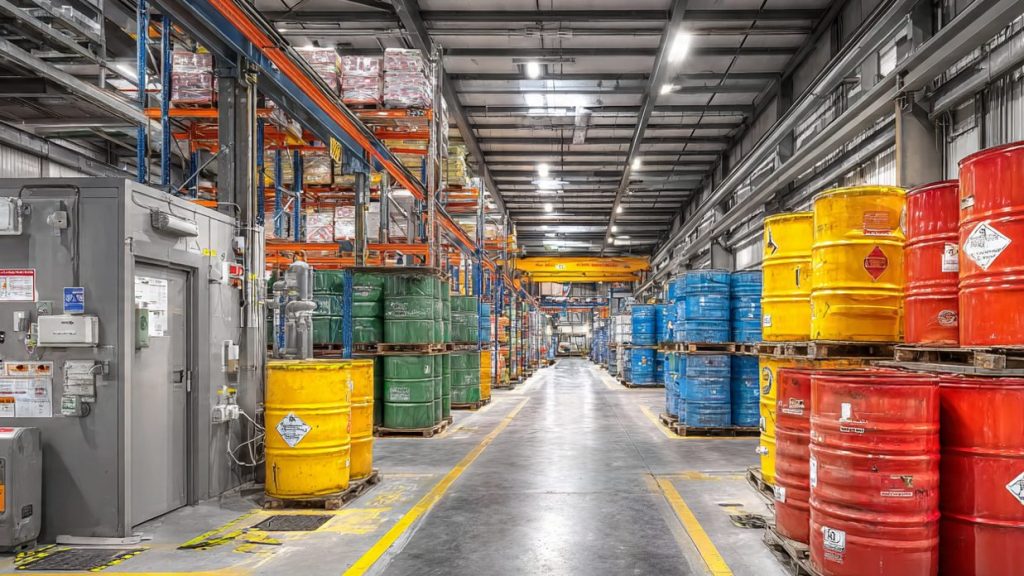
- Hazardous liquid storage in the UAE requires impervious secondary containment (bunding) with a capacity of at least 110% of the largest tank/IBC or 25% of the total stored volume, whichever is greater (verify against the applicable emirate-level guideline and permit conditions) [1].
- Outdoor chemical/solvent drum stores in the UAE summer require sun shading, thermal relief, and flame-proof (Ex) ventilation [1][2].
- Pre-acceptance testing at UAE Class 1 hazardous landfills requires ISO 17025 accredited TCLP (EPA 1311) and WAC leaching analysis [2].
- Reactive, flammable (flash point ≤60 °C), or liquid wastes are banned from direct landfilling and require physical-chemical or thermal treatment [1][2].
Plain English — the essentials, in everyday language
Plain English
What this topic covers and why it matters in practice
Under UAE Federal Law No. (12) of 2018 and Cabinet Resolution No. (39) of 2021, industrial generators of hazardous waste—including spent solvents, waste mineral oils, chemical sludges, blasting grit, lead-acid batteries, and asbestos—must characterize streams through ISO 17025 accredited laboratories (using TCLP Method 1311 and total contaminant analysis), store drums in shaded, bunded, ventilated bays with 110% secondary containment, and obtain prior disposal permits for treatment at licensed facilities (such as Jebel Ali in Dubai, EcoWaste/Al Dhafra in Abu Dhabi, or Al Saja’a in Sharjah).
How the four-stage operational pathway works
To apply this guidance reliably, project teams and students should follow four sequential stages: (1) 1. ISO 17025 Lab Profiling (TCLP Method 1311, Flash Point, pH, Metals); (2) 2. Shaded, Segregated & 110%-Bunded On-Site Storage with GHS/SDS Labels; (3) 3. Authority Pre-Acceptance Approval & Hazmat E-Manifest; and (4) 4. Stabilization + Double-Lined Cell or Rotary-Kiln Incineration. Each stage has a clear verification check before moving to the next.
Professional layer — engineering, operations & compliance detail (click to expand)
Professional
Engineering, Regulatory & Quality-Control Requirements
Hazardous liquid storage in the UAE requires impervious secondary containment (bunding) with a capacity of at least 110% of the largest tank/IBC or 25% of the total stored volume, whichever is greater (verify against the applicable emirate-level guideline and permit conditions) [1]. Outdoor chemical/solvent drum stores in the UAE summer require sun shading, thermal relief, and flame-proof (Ex) ventilation [1][2]. Pre-acceptance testing at UAE Class 1 hazardous landfills requires ISO 17025 accredited TCLP (EPA 1311) and WAC leaching analysis [2]. Reactive, flammable (flash point ≤60 °C), or liquid wastes are banned from direct landfilling and require physical-chemical or thermal treatment [1][2]. Practitioners must verify current permit conditions, laboratory test methods, and competent authority guidelines before finalising project specifications or operational procedures.
Field Implementation & Documentation Checklist
1. Establish baseline records for 1. ISO 17025 Lab Profiling (TCLP Method 1311, Flash Point, pH, Metals). 2. Implement documented controls for 2. Shaded, Segregated & 110%-Bunded On-Site Storage with GHS/SDS Labels and 3. Authority Pre-Acceptance Approval & Hazmat E-Manifest. 3. Retain auditable certificates, weighbridge logs, or inspection records for 4. Stabilization + Double-Lined Cell or Rotary-Kiln Incineration in the project quality register.
Common questions
Where should project teams verify the primary requirements for UAE Hazardous & Industrial Waste Permitting?
Always consult the primary instrument or technical guideline published by the competent authority (for example, EAD/Tadweer guidance in Abu Dhabi or Dubai Municipality hazardous waste guidelines in Dubai, together with MOCCAE requirements and Cabinet Resolution No. (39) of 2021 at federal level) alongside site-specific permit conditions [1].
Can general guidance replace a site-specific engineering or legal review?
No. Knowledge Hub articles explain the technical and regulatory structure, but project decisions must be based on the approved project design, laboratory data, and competent authority instructions.
References
Show all 2 sources
- Competent emirate-level authority hazardous waste guidance. For Abu Dhabi, see the Environment Agency – Abu Dhabi (EAD) and Tadweer hazardous waste policies and technical guidance. For Dubai, see the Dubai Municipality Waste Management Department hazardous waste guidelines and e-manifest system. Verify current titles and editions on each authority’s website. EAD available at: https://www.ead.gov.ae
- United Arab Emirates (2018) Federal Law No. (12) of 2018 on Integrated Waste Management. Available at: https://elaws.moj.gov.ae
About this article
Charmaine Frost is a landfill gas and waste-management specialist and a founding director of Qualifrost FZC LLC, drawing on UK Tier-1 operational and engineering experience with major waste-management companies. She holds the NEBOSH International General Certificate and has submitted her final NEBOSH Diploma assessment, with results expected in March–April 2027.
Reviewed by Adrian Frost, Director. Checked against primary statutory instruments and recognised technical standards.