

Plastics Recycling: Mechanical, Chemical, Polymer Types and Resin Codes
In short
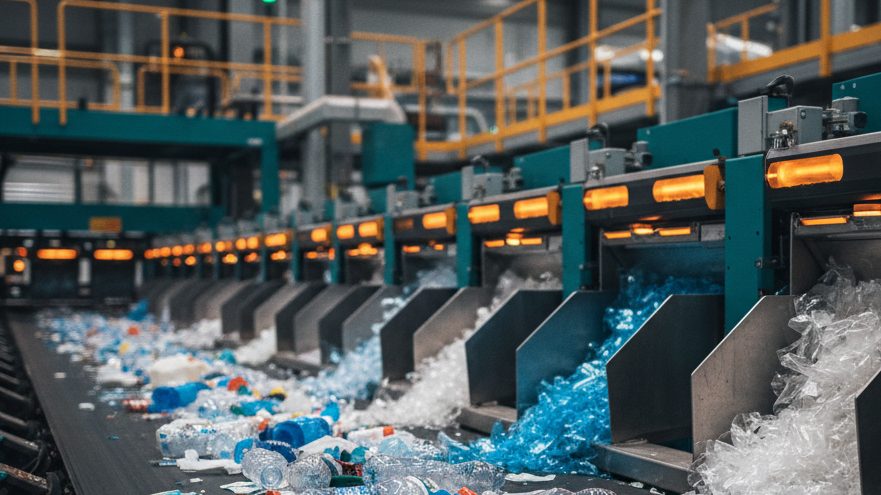
Plastics recycling converts used plastic into new material by one of two routes. Mechanical recycling sorts, washes, shreds and melts plastic without changing its chemistry, and handles almost all plastic recycled today. Chemical recycling breaks polymers back into their building blocks, which allows food-grade output and tolerates mixed material, but it is energy-intensive and barely deployed at scale. The global plastic recycling rate is around 9%. Recovery varies enormously by polymer: PET achieves roughly 27% globally, while PVC and mixed plastics are close to zero. The resin code stamped on an item identifies the polymer; it does not mean the item is recyclable where you live.
- 1CollectionSeparately collected plastics
- 2SortingBy polymer and colour, often with NIR sensors
- 3WashingRemove labels, dirt and residues
- 4Size reductionShred into flake
- 5ExtrusionMelt, filter and pelletise
- 6New productsPellets used by manufacturers
Key facts
- The global plastic recycling rate is about 9%, against annual production of more than 400 million tonnes [1]
- PET (code 1) achieves roughly 27% globally; HDPE (code 2) about 25%; PVC (code 3) and code 7 mixed plastics are effectively zero [2]
- Mechanical recycling dominates. In the EU27+3, of 29.5 Mt post-consumer plastic collected, 9.1 Mt went to mechanical recycling and under 0.1 Mt to chemical [3]
- Investment cost per tonne per day of capacity is roughly USD 2,000–10,000 for mechanical against USD 857,000 for pyrolysis [4]
- Chemical recycling technology readiness sits at TRL 3–7 — not yet ready for general commercial deployment [4]
- UAE Ministerial Resolution 380/2022 banned single-use plastic bags from 1 January 2024, with cups, cutlery, plates, straws, stirrers and polystyrene following from 1 January 2026 [5]
- Mechanical recycling outperforms chemical recycling on climate impact across the polymer types assessed [4]
Plain English — the essentials, in everyday language
Plain English
What the number in the triangle means
The number stamped on a plastic item tells you which polymer it is made from. It does not tell you it will be recycled.
This is the single most common misunderstanding about plastic. The Resin Identification Code was created to help sorters, not shoppers.
| Code | Polymer | Common items | Realistic recovery |
|---|---|---|---|
| 1 | PET | Drinks bottles | Good, around 27% globally [2] |
| 2 | HDPE | Milk jugs, detergent bottles | Good, around 25% [2] |
| 3 | PVC | Pipes, cables, garden furniture | Close to zero [2] |
| 4 | LDPE | Bags, film, wraps | Low, around 5% [2] |
| 5 | PP | Tubs, furniture, car parts | Low [2] |
| 6 | PS | Packaging, foam, CD cases | Close to zero [2] |
| 7 | Other | Nylon, PLA, multilayer | Close to zero [2] |
Codes 1 and 2 are worth collecting almost everywhere. Codes 3, 6 and 7 rarely are.
The two ways to recycle plastic
Mechanical recycling is the workhorse. The plastic is collected, sorted by type, washed, shredded into flakes, then melted and formed into pellets. The chemistry never changes.
It is cheap and well understood. It does nearly all the plastic recycling happening in the world today [3]. Its weakness is that the polymer degrades slightly each cycle. Material gradually drops to lower-grade uses.
Chemical recycling breaks the plastic back down into the molecules it was built from. Those can then be used to make new plastic of original quality, including food-grade.
It sounds like the answer to everything. In practice it uses far more energy and costs much more to build. It is barely deployed. Across the EU27+3, under 0.1 million tonnes went to chemical recycling against 9.1 million tonnes mechanical [3].
Why so little plastic gets recycled
Around 9% globally [1]. Several reasons compound:
Sorting is hard. Different polymers look identical. A PET bottle with a PVC label contaminates the whole batch.
Virgin plastic is cheap. When oil prices are low, new plastic often costs less than recycled.
Multilayer packaging cannot be separated. A crisp packet may be three materials bonded together. No process separates them at a sensible cost.
Contamination spoils loads. Food residue, wrong polymers, or non-plastic items can downgrade an entire collection.
What actually helps
- Rinse containers. A greasy tub can spoil the material around it
- Leave caps on bottles where your local scheme says to — modern sorting handles them
- Do not bag your recycling unless instructed. Bags jam sorting equipment
- Stick to codes 1 and 2 if your local scheme is unclear. They have real markets
- Reduce first. No recycling process beats not producing the waste
In the UAE and the Gulf
The UAE is phasing out single-use plastics on a fixed timetable. Ministerial Resolution 380/2022 banned single-use plastic bags from 1 January 2024. That ban included biodegradable bags. From 1 January 2026 it widened to cups and lids, cutlery, plates, straws, stirrers and polystyrene food containers. It also covers all bags under 50 microns, in any material, including paper [5].
Plastic consumption per person is high across the GCC. Hot weather drives bottled water use, and packaged goods dominate retail. Abu Dhabi, Dubai and Sharjah all run separate collection schemes, so the practical rules change as you cross emirate boundaries.
Bin colours differ between emirates in the UAE. The federal scheme under Cabinet Resolution 39/2021 uses green for recyclables. Dubai Municipality uses green for organic waste and yellow for dry recyclables [6]. Read the label, not the colour.
Contamination carries a direct cost. In Dubai a clean recyclable load can be collected at nil cost. Once contaminated, it is reclassified as general waste at AED 100 per tonne [7].
Professional layer — engineering, operations & compliance detail (click to expand)
Professional
Mechanical recycling process train
Six stages: collection, sorting by polymer, washing, shredding, separation by quality, and extrusion or compounding into pellets.
| Stage | Governing variable | Failure mode |
|---|---|---|
| Sorting | NIR spectral separation accuracy | Black plastic invisible to standard NIR |
| Washing | Water temperature, detergent, residence | Residual organics degrade melt quality |
| Shredding | Screen size, blade condition | Fines generation, yield loss |
| Density separation | Float-sink medium calibration | PVC/PET misclassification |
| Extrusion | Melt temperature, filtration mesh | Thermal degradation, gel formation |
Black plastic remains a systemic problem. Carbon black absorbs near-infrared, making items invisible to conventional NIR sorters. Detectable alternative pigments exist but are not universally adopted, so most black packaging still bypasses recovery regardless of polymer.
Chemical recycling: honest positioning
The techniques — pyrolysis, gasification, solvolysis, depolymerisation — differ, but share a commercial profile:
| Metric | Mechanical | Chemical |
|---|---|---|
| Investment per tonne/day capacity | USD 2,000–10,000 [4] | USD 385,000 (gasification) to 857,000 (pyrolysis) [4] |
| Technology readiness | Mature | TRL 3–7 [4] |
| Climate impact | Lower [4] | Higher across polymers assessed [4] |
| Output quality | Degrades per cycle | Can reach virgin/food grade |
| Contamination tolerance | Low | Higher, but sorting still required [4] |
Two orders of magnitude separate the capital costs. That gap, not technical possibility, is why deployment remains marginal. Chemical recycling has a genuine role for streams mechanical recycling cannot serve — multilayer film, mixed or contaminated polyolefins — and should be positioned as complementary rather than as a replacement. PVC must generally be removed from chemical recycling feedstock, because it releases hydrogen chloride during processing.
Treat any business case claiming chemical recycling is cheaper or lower-carbon than mechanical for a stream mechanical can handle as a case requiring independent verification.
Market and specification
Recyclate value follows polymer, colour and contamination. Clear PET and natural HDPE command the highest prices; mixed colour and film sit lowest. Price indices are published by letsrecycle and EUWID [8].
For fuel applications, EN 15359 classifies solid recovered fuel by net calorific value, chlorine content and mercury [9]. For compostable plastics, EN 13432 sets the compostability standard — and note that compostable and biodegradable are not interchangeable terms, nor are either recyclable.
Regulatory position
UAE. Ministerial Resolution 380/2022 phases out single-use plastics on the timetable above, with exemptions for export, medicine and refuse bags, and thin fresh-food wrap [5]. Dubai applies Executive Council Resolution 124/2023 separately.
EU. The Waste Framework Directive requires separate collection of plastic (Art. 11) [10]. The Single-Use Plastics Directive restricts specified items and sets PET recycled content requirements.
Global. The UNEP Intergovernmental Negotiating Committee process on plastic pollution continues. It is a negotiation, not law — date-stamp any statement about its content [1].
Practitioner notes
- Specify the polymer, not “plastic,” in any waste contract. A contract for “plastic recycling” without polymer specification permits the contractor to landfill codes 3 to 7 while remaining compliant
- Audit the destination, not the collection. Collection segregation is visible; what happens at the reprocessor is not. Request the reprocessor’s output certificates
- Design out multilayer where you control specification. A mono-material pack at slightly higher unit cost is recyclable; a multilayer pack at lower cost is not
- Do not accept “recyclable” as a claim without a route. A material is only recyclable if collection, sorting and a reprocessing market all exist in the jurisdiction of use
Common questions
Does the number on a plastic item mean it can be recycled? No. It identifies the polymer only. Codes 1 and 2 have established markets almost everywhere. Codes 3, 6 and 7 are rarely recycled anywhere [2].
Why is only 9% of plastic recycled? Sorting difficulty, cheap virgin material, multilayer packaging that cannot be separated, and contamination all compound. The rate has stayed low despite three decades of resin coding [1].
Is chemical recycling better than mechanical? Not for streams mechanical can handle. Mechanical has lower climate impact and costs two orders of magnitude less to build [4]. Chemical recycling matters for mixed and contaminated streams mechanical cannot process.
Can black plastic be recycled? Rarely. Carbon black pigment absorbs the near-infrared light that sorting machines use, so black items pass through undetected regardless of polymer.
What changed in the UAE in 2026? From 1 January 2026 the single-use plastic ban extended to cups and lids, cutlery, plates, straws, stirrers and polystyrene containers, plus all bags under 50 microns of any material [5].
References
Show all 10 sources
- Plastic recycling: A panacea or environmental pollution problem (2024). Nature npj Materials Sustainability. Reports global recycling rate of 9% against production exceeding 400 million tonnes annually. Available at: https://www.nature.com/articles/s44296-024-00024-w (Accessed: 25 August 2026).
- Fundamental, technical and environmental overviews of plastic chemical recycling (2024). Royal Society of Chemistry, Green Chemistry. Recovery rates by SPI resin code. Available at: https://pubs.rsc.org/en/content/articlehtml/2024/gc/d4gc03127j (Accessed: 25 August 2026).
- Plastics Europe, cited in RSC Green Chemistry (2024). Of 29.5 Mt post-consumer plastic collected in EU27+3, 9.1 Mt to mechanical recycling and under 0.1 Mt to chemical. Available at: https://pubs.rsc.org/en/content/articlehtml/2024/gc/d4gc03127j (Accessed: 25 August 2026).
- National Institute of Standards and Technology (2024) The U.S. Plastics Recycling System, NIST Advanced Manufacturing Series 100-64. Capital cost and TRL comparison. Available at: https://nvlpubs.nist.gov/nistpubs/ams/NIST.AMS.100-64.pdf (Accessed: 25 August 2026).
- Ministry of Climate Change and Environment (2022) Ministerial Resolution No. 380 of 2022 Regarding the Regulation of the Use of Single-Use Products. UAE Legislation Portal. Available at: https://uaelegislation.gov.ae/en (Accessed: 25 August 2026).
- UAE Cabinet (2021) Cabinet Resolution No. 39 of 2021 on waste segregation and colour coding. UAE Legislation Portal. Available at: https://uaelegislation.gov.ae/en (Accessed: 25 August 2026).
- Dubai Municipality (2026) Waste disposal gate fee schedule 2026. General waste AED 100/t. Confirm current rates with Dubai Municipality before commercial reliance.
- letsrecycle (2026) Recyclate price indices. Available at: https://www.letsrecycle.com/prices/ (Accessed: 25 August 2026).
- CEN (2011) EN 15359 Solid recovered fuels — Specifications and classes. European Committee for Standardization. Available at: https://www.cencenelec.eu/ (Accessed: 25 August 2026).
- European Union (2008) Directive 2008/98/EC on waste (Waste Framework Directive), Art. 11. Available at: http://data.europa.eu/eli/dir/2008/98/oj (Accessed: 25 August 2026).
Related articles
Start here – Plastic Waste
Related – Paper & Cardboard Recycling – Glass Recycling – Metal Recycling – Chemical / Advanced Recycling
Go deeper – Material Recovery Facilities (MRF) – Optical / NIR Sorting – Extended Producer Responsibility (EPR) – Design for Disassembly / Recyclability
About this article
Charmaine Frost is a landfill gas and waste-management specialist and a founding director of Qualifrost FZC LLC. Her experience was gained with major UK waste-management companies, covering landfill gas generation and collection systems, environmental monitoring and the practical risks of landfill operations. She holds the NEBOSH International General Certificate and has submitted her final NEBOSH Diploma assessment, with results expected in March–April 2027.
Reviewed by Adrian Frost, Director. Every article is checked against primary sources before publication: legal claims are verified against the instrument itself, and figures against the original dataset.
Published 25 August 2026 · Last reviewed 25 August 2026 · Next review August 2027, or sooner if the law changes.