

Material Recovery Facilities (MRF): Clean vs Dirty, Equipment and Throughput
In short
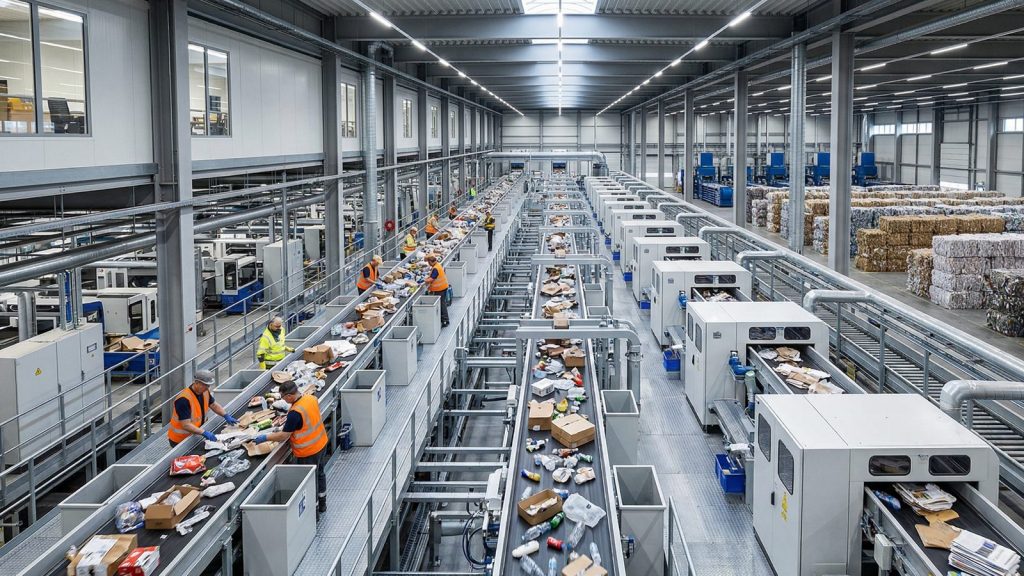
A material recovery facility, or MRF, is a plant that separates mixed recyclable material into individual commodity streams ready for reprocessing. A clean MRF receives material already separated at source and produces high-quality output. A dirty MRF receives mixed municipal waste and pulls recyclables out of it, producing lower-grade material at higher cost. Sorting combines mechanical stages such as trommel screens, magnets and eddy current separators with optical near-infrared units and manual picking. Recovery rates depend far more on the quality of incoming material than on the equipment installed, which is why segregation at source governs MRF performance.
- 1Tipping and pre-sortBulky items and contaminants removed
- 2ScreeningBag opening and trommel screening by size
- 3Ballistic separationFlat 2D items split from rolling 3D containers
- 4Metals recoveryMagnets for steel, eddy current for aluminium
- 5Optical sortingNIR sensors and air jets separate polymers and paper grades
- 6Quality controlFinal hand picking to meet market specification
- 7BalingProducts baled, stored and sold
Key facts
- A clean MRF handles source-separated material; a dirty MRF processes mixed municipal waste and produces lower-grade output at higher cost [10]
- Black plastic is invisible to standard near-infrared sorters because carbon black absorbs the detection wavelength, so it bypasses recovery regardless of polymer [1]
- Mechanical recycling handles almost all recovered plastic: in the EU27+3, 9.1 Mt went to mechanical against under 0.1 Mt chemical [2]
- About 50% of household-generated waste in the EU still reaches the mixed bin, limiting what any clean MRF can receive [3]
- Organic waste is around 40% of UAE municipal waste — the main contaminant in a Gulf dirty MRF [4]
- EU law requires separate collection of paper, metal, plastic and glass, which is what makes clean MRFs viable [5]
- Dubai charges AED 100 per tonne for general waste, so MRF residue carries a direct disposal cost [6]
Plain English — the essentials, in everyday language
Plain English
What a MRF does
A material recovery facility is a sorting plant. Recycling collected from homes and businesses arrives mixed together. The MRF separates it into single materials — paper, cardboard, steel, aluminium, and different plastics — so each can be sold to a reprocessor.
Nothing is recycled at a MRF. It sorts. The actual recycling happens elsewhere, at a paper mill or a plastics reprocessor.
Clean MRF and dirty MRF
The difference is what arrives at the door.
A clean MRF takes material that householders already separated. The load is mostly recyclable to begin with, so output is high quality and sells well.
A dirty MRF takes ordinary mixed rubbish and tries to pull recyclables out. It recovers material that would otherwise be buried, but everything is contaminated by food and liquid. Paper is the biggest casualty, because once wet and greasy it cannot be made into good paper again.
A dirty MRF costs more to run and produces material worth less. It exists where source separation has not been established.
Inside the sorting line
Material moves along conveyors through a series of stages, each removing something:
- Manual pre-sort — workers remove large or dangerous items: gas cylinders, textiles, hoses that would wrap around machinery
- Trommel screen — a large rotating drum with holes, separating material by size
- Magnet — an overhead magnet lifts out steel cans
- Eddy current separator — a rapidly changing magnetic field physically repels aluminium off the belt
- Optical sorters — near-infrared light identifies each plastic type, then a jet of air fires the target into a separate chute
- Ballistic separator — bounces flat items one way and rounded items another
- Quality control picking — people remove what the machines missed
The output is baled into blocks of single material and sold.
Why contamination matters so much
A MRF is only as good as what goes into it.
Food residue soaks into paper. Plastic bags wrap around rotating shafts and stop the line. Broken glass embeds itself in cardboard. Batteries start fires.
One awkward truth of the industry: modern sorting equipment is very capable, but no amount of technology fixes badly separated input. This is why segregation at source matters more than the machinery.
The black plastic problem
Optical sorters work by shining near-infrared light at material and reading the reflection. Every polymer reflects differently, which is how the machine knows what it is looking at.
Carbon black absorbs that light rather than reflecting it. A black plastic tray is effectively invisible to the sensor, so it passes through unsorted and ends up in the residue [1]. Detectable pigments exist, but are not widely used yet.
In the UAE and the Gulf
Organic content is the main challenge. Around 40% of UAE municipal waste is organic [4]. In a dirty MRF, that wet fraction contaminates everything it touches, and heat accelerates the problem.
Heat affects the working environment across the GCC. Sorting halls need serious ventilation and cooling. This is a health and safety requirement, not a comfort one, and the IFC guidelines treat it as a design obligation for waste facilities [10].
Residue has a price. Whatever a MRF cannot recover goes to disposal at AED 100 per tonne in Dubai [6]. Residue rate is therefore a direct financial line, not just an efficiency measure.
Segregation is being pushed. Dubai Law 18/2024 lets the Municipality require producers to implement segregation and sorting (Art. 16) [7], which over time improves what MRFs receive.
Professional layer — engineering, operations & compliance detail (click to expand)
Professional
Clean versus dirty: selection criteria
| Factor | Clean MRF | Dirty MRF |
|---|---|---|
| Input | Source-separated dry recyclables | Mixed municipal solid waste |
| Output grade | High, sells at commodity price | Low, discounted or rejected |
| Residue rate | Low | High |
| Capital cost per tonne capacity | Lower | Higher |
| Operating cost | Lower | Higher — more stages, more wear |
| Precondition | Effective source separation | None |
A dirty MRF is a transitional solution. It makes sense where source separation does not yet exist and diversion is required now. It should be planned with a migration path to clean-MRF operation as segregation matures, not as a permanent endpoint.
Equipment selection and sequencing
| Stage | Function | Design sensitivity |
|---|---|---|
| Pre-sort | Remove oversize and hazards | Understaffing here damages everything downstream |
| Trommel | Size fractionation | Aperture selection governs fines split |
| Magnetic separator | Ferrous recovery | Belt speed and burden depth |
| Eddy current | Non-ferrous recovery | Rotor speed; fines reduce efficiency |
| Optical NIR | Polymer and fibre separation | Blind to carbon black [1]; burden depth critical |
| Ballistic | 2D/3D separation | Screen angle governs film carryover |
| QC picking | Final purity | Ergonomics and rotation determine sustained accuracy |
Burden depth is the most commonly mis-specified variable. Optical and eddy current stages both require material presented as a thin, evenly distributed layer. Overloading a line to raise throughput degrades separation efficiency across every downstream stage simultaneously.
Throughput and availability
Nameplate capacity is a marketing figure. Model against:
- Availability — planned and unplanned downtime, jams, cleaning
- Burden depth constraint — actual sustainable feed rate, usually below nameplate
- Composition variance — a high-film load slows a line more than a high-container load
- Shift pattern — single-shift plants need higher hourly rates for the same annual tonnage
Specify guarantees on annual tonnage at defined purity, not on hourly nameplate. A line that meets nameplate at 70% purity has failed commercially while passing its acceptance test.
Recovery and purity targets
Two metrics, always paired:
- Recovery rate — proportion of target material captured from the input
- Purity — proportion of the output bale that is genuinely the target material
They trade against each other. Pushing recovery up drags contamination into the output; pushing purity up sends recoverable material to residue. Reprocessor specifications set the purity floor, and that fixes the achievable recovery.
Economics
Revenue comes from baled commodity sales, priced against published indices [8]. Cost is labour, energy, maintenance and residue disposal.
Residue disposal is the line most often underestimated. At AED 100 per tonne in Dubai [6], a five-percentage-point increase in residue rate on a 100,000 tonne per year plant costs AED 500,000 annually. That is usually more than the maintenance saving from running equipment harder.
Commodity prices are volatile. Model the business case at long-run average prices with downside sensitivity, not at spot.
Practitioner notes
- Specify fire detection and suppression at design stage. Lithium-ion batteries in the input stream are the dominant fire risk in modern MRFs, and retrofit is far more expensive than design-in
- Design the pre-sort station properly. It is the least glamorous and highest-leverage position on the line. Everything the pre-sort misses damages equipment downstream
- Sample and characterise input before procurement using ASTM D5231-92(2024) [9]. Equipment selected against an assumed composition rather than a measured one is the most common cause of underperformance
- Contract for purity, not tonnage. A plant paid per tonne processed has no incentive to produce saleable output
Common questions
What does a MRF actually do? It sorts mixed recyclable material into separate streams of single materials, then bales them for sale. It does not recycle anything itself — that happens at reprocessors.
What is the difference between a clean MRF and a dirty MRF? A clean MRF receives material already separated by householders and produces high-quality output. A dirty MRF receives mixed rubbish and extracts recyclables from it, producing lower-grade material at higher cost.
Why can’t machines sort black plastic? Optical sorters identify materials using reflected near-infrared light. Carbon black pigment absorbs that light, so black items are effectively invisible to the sensor and pass through unsorted [1].
Does putting recycling in a plastic bag help? No, it causes problems. Bags wrap around rotating equipment and cause stoppages, and bagged material is often rejected because the contents cannot be identified.
How much of what arrives at a MRF is actually recovered? It depends almost entirely on input quality rather than equipment. Clean, source-separated input yields high recovery; mixed waste yields much less, and the recovered material is worth less.
References
Show all 10 sources
- Fundamental, technical and environmental overviews of plastic chemical recycling (2024). Royal Society of Chemistry, Green Chemistry. Discusses NIR sorting limitations including carbon black detection. Available at: https://pubs.rsc.org/en/content/articlehtml/2024/gc/d4gc03127j (Accessed: 25 August 2026).
- Plastics Europe, cited in RSC Green Chemistry (2024). EU27+3 post-consumer plastic: 9.1 Mt mechanical recycling against under 0.1 Mt chemical. Available at: https://pubs.rsc.org/en/content/articlehtml/2024/gc/d4gc03127j (Accessed: 25 August 2026).
- European Commission Joint Research Centre (2025) Comprehensive assessment of environmental and economic impacts of the entire EU waste management system. JRC141204. Available at: https://publications.jrc.ec.europa.eu/repository/handle/JRC141204 (Accessed: 25 August 2026).
- Fast Company Middle East (2026) UAE’s circular economy goals hinge on stronger organic waste management. Organic waste at nearly 40% of UAE municipal waste. Available at: https://fastcompanyme.com/news/uaes-circular-economy-goals-hinge-on-stronger-organic-waste-management/ (Accessed: 25 August 2026).
- European Union (2008) Directive 2008/98/EC on waste (Waste Framework Directive), Art. 11. Available at: http://data.europa.eu/eli/dir/2008/98/oj (Accessed: 25 August 2026).
- Dubai Municipality (2026) Waste disposal gate fee schedule 2026. General waste AED 100/t. Confirm current rates with Dubai Municipality before commercial reliance.
- Government of Dubai (2024) Law No. (18) of 2024 Regulating Waste Management in the Emirate of Dubai, Art. 16. Dubai Legislation Portal. Available at: https://dlp.dubai.gov.ae/en (Accessed: 25 August 2026). Arabic text prevails.
- letsrecycle (2026) Recyclate price indices. Available at: https://www.letsrecycle.com/prices/ (Accessed: 25 August 2026).
- ASTM International (2024) ASTM D5231-92(2024) Standard Test Method for Determination of the Composition of Unprocessed Municipal Solid Waste. Available at: https://www.astm.org/d5231-92r24.html (Accessed: 25 August 2026).
- International Finance Corporation (2007) Environmental, Health, and Safety Guidelines for Waste Management Facilities. World Bank Group. Available at: https://www.ifc.org/en/insights-reports/general-environmental-health-and-safety-guidelines/ehs-guidelines-infrastructure (Accessed: 25 August 2026).
Related articles
Start here – Segregation at Source
Related – Manual vs Automated Sorting – Optical / NIR Sorting – Eddy Current & Magnetic Separation – Ballistic Separators
Go deeper – Plastics Recycling – Paper & Cardboard Recycling – AI-Powered Sorting (Robotics) – Transfer Stations
About this article
Charmaine Frost is a landfill gas and waste-management specialist and a founding director of Qualifrost FZC LLC. Her experience was gained with major UK waste-management companies, covering landfill gas generation and collection systems, environmental monitoring and the practical risks of landfill operations. She holds the NEBOSH International General Certificate and has submitted her final NEBOSH Diploma assessment, with results expected in March–April 2027.
Reviewed by Adrian Frost, Director. Every article is checked against primary sources before publication: legal claims are verified against the instrument itself, and figures against the original dataset.
Published 25 August 2026 · Last reviewed 25 August 2026 · Next review August 2027, or sooner if the law changes.