

Eddy Current and Magnetic Separation: Ferrous and Non-Ferrous Recovery
Magnets and eddy current separators recover the highest-value fractions in most waste lines. This guide explains how each works, the recovery rates achievable by particle size, why the magnet must always come first, and how to specify and tune both for the material you actually have.
By Charmaine Frost, Director and Landfill Gas Specialist
In short
Magnetic separation uses a static magnetic field to attract ferrous metals, achieving 95 to 99 per cent recovery at 8 to 15 tonnes per hour and low capital cost [1]. Eddy current separation uses a high-speed rotating magnetic rotor, typically around 3,000 rpm, to induce circulating currents in conductive non-ferrous particles, generating a repulsive force that throws aluminium, copper, brass and zinc forward off the belt while inert material falls short [2][3]. Non-ferrous recovery runs 85 to 97 per cent when feed is properly classified [3]. The magnet always precedes the eddy current unit: a steel slug at 3,000 rpm punches through the belt cover and permanently weakens the rotor field [3].
Key facts
- Magnetic separation achieves 95 to 99 per cent accuracy at 8 to 15 tonnes per hour and is the lowest-cost separation stage; eddy current runs 90 to 95 per cent at 5 to 10 tonnes per hour [1].
- Eddy current rotors typically revolve at around 3,000 rpm inside a separately rotating non-metallic drum whose cover turns at belt speed [2].
- High-tonnage separators use rare earth magnet blocks achieving over 5 kG, or 0.5 T, at the conveyor belt surface, and field depth limits how thick the scrap layer can be [4].
- A UK metal separation line recovers approximately 96 to 97 per cent of non-ferrous metal from a feed with around 25 per cent metal content at about 10 tonnes per hour [2].
- Concentric rotors suit 20 to 150 mm at 2,000 to 3,500 rpm with 90 to 95 per cent recovery; eccentric rotors suit 5 to 50 mm at 3,000 to 5,000 rpm with 85 to 93 per cent [5].
- Aluminium recovery falls with particle size: 96 to 99 per cent above 50 mm, 88 to 94 per cent at 10 to 20 mm, and 65 to 80 per cent at 3 to 5 mm [5].
- Recovered aluminium generates USD 800 to 1,500 per tonne, often the highest-value stream in municipal solid waste recycling [5].
- Waste-to-energy bottom ash typically contains around 1 to 5 per cent non-ferrous metals by weight, with ferrous metal the larger fraction at typically 5 to 15 per cent; the recoverable value per tonne of ash depends on metal prices and plant performance and should be verified against current industry data.
Plain English — the essentials, in everyday language
Plain English
Two different jobs
A magnet picks up iron and steel. It cannot touch aluminium or copper, because those metals are not magnetic.
An eddy current separator does the opposite job. It cannot pick up steel. It throws aluminium and copper forward off the end of a belt.
You need both. They sit in sequence, magnet first.
How magnetic separation works
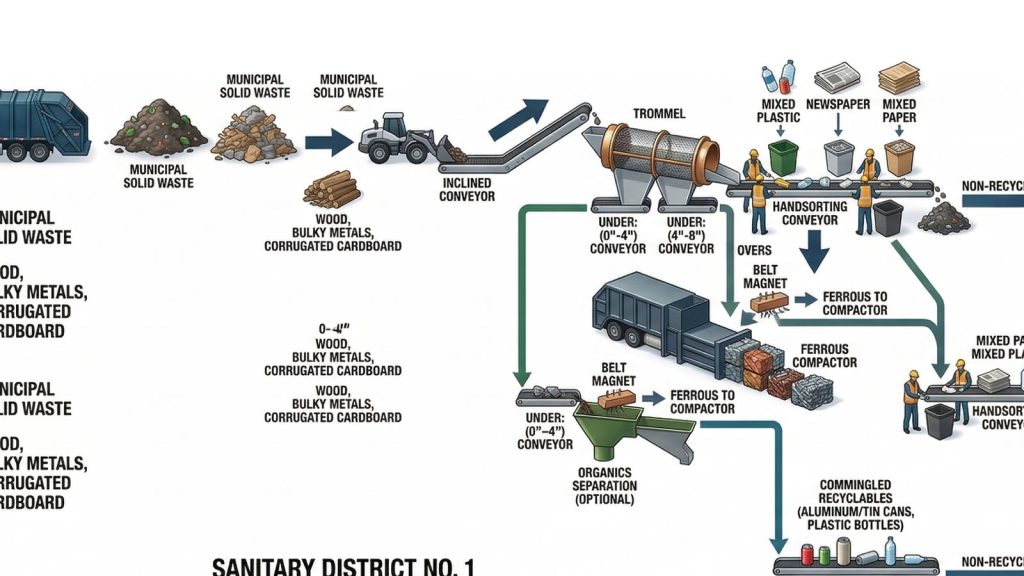
This part is simple. A strong magnet sits above or around the material stream. Ferrous items stick to it and are carried away to a separate chute.
An overband magnet hangs above a conveyor. A magnetic drum forms the end pulley of a belt, so non-magnetic material falls off and magnetic material is carried round.
Recovery is high, at 95 to 99 per cent, and it is cheap [1].
How eddy current separation works
This one is less obvious. A drum at the end of a conveyor contains a magnet rotor spinning very fast, around 3,000 revolutions a minute [2].
That spinning field induces an electric current inside any conductive metal passing over it. That current creates its own magnetic field.
The two fields push against each other. The metal is thrown forward, off the end of the belt, past a splitter plate. Plastic and glass just drop.
Why the magnet must go first
Three reasons, and they all cost money.
A single piece of steel hitting a rotor at 3,000 rpm punches through the belt cover [3].
Repeated heat and impact at the magnet face permanently weakens the rotor field. Recovery rates fall and never come back [3].
Iron in the recovered aluminium is a deal-breaker for metal buyers [3].
Size matters enormously
Eddy current recovery depends heavily on how big the pieces are.
Whole cans above 50 mm give 96 to 99 per cent recovery. Coarse shred at 20 to 50 mm gives 93 to 97 per cent. Medium fraction at 10 to 20 mm gives 88 to 94 per cent [5].
Below that it drops fast. Fine fraction at 5 to 10 mm gives 80 to 90 per cent, and very fine at 3 to 5 mm gives only 65 to 80 per cent [5].
That is why a screen sits between the magnet and the eddy current unit.
Tuning pays
You can improve recovery without buying anything. Rotor speed and belt speed both need matching to the fraction.
On a 5 tonne per hour line with 2 per cent aluminium, raising recovery from 80 to 93 per cent yields roughly 26 extra tonnes of aluminium a year per shift [5]. That is margin from adjustment, not capital.
Why it is worth doing
Aluminium sells for USD 800 to 1,500 a tonne and is often the most valuable thing in municipal waste [5].
Bottom ash from waste-to-energy plants typically contains around 1 to 5 per cent non-ferrous metal, plus a larger share of iron and steel. What that metal is worth per tonne of ash depends on metal prices and how well the plant recovers it.
In the Gulf
Abu Dhabi’s 400,000 tonne per year material recovery facility, awarded to Urbaser for 2028 operation, uses automated sorting and recovery systems, with recovered material prepared for onward processing at the waste-to-energy facility under development [6].
That pairing matters here. A waste-to-energy plant generates bottom ash, and bottom ash metal recovery is where fine-fraction eddy current capability earns its cost.
Professional layer — engineering, operations & compliance detail (click to expand)
Professional
Magnetic separation configurations
Three configurations dominate.
Overband magnets suspend above a conveyor, either cross-belt or in-line, and lift ferrous items clear of the burden. They suit coarse material with variable burden depth and are the standard first stage on mixed municipal and commercial lines.
Magnetic drums form the head pulley of a conveyor, so non-magnetic material discharges on a ballistic trajectory while ferrous material is held to the shell and released beyond the splitter. Alternating pole configurations produce the cleanest ferrous fraction because the tumbling action releases entrapped non-magnetic material [2].
Magnetic pulleys and drums using high-strength rare earth elements also capture weakly magnetic material such as certain stainless grades, which standard ferrite systems miss.
Performance is 95 to 99 per cent recovery at 8 to 15 tonnes per hour at the lowest capital cost of any separation stage in the plant [1]. Maintenance is minimal, essentially cleaning off captured ferrous material [3].
Eddy current physics and rotor design
The eddy current separator comprises a short belt conveyor with the drive at the return end and a high-speed magnetic rotor at the discharge end. The rotor sits inside a separately rotating non-metallic drum; the rotor spins at around 3,000 rpm while the outer cover turns at belt speed [2].
Alternating polarity magnet arrays generate a rapidly changing field. Conductive non-ferrous particles passing through develop circulating eddy currents whose induced field opposes the rotor field, producing a Lorentz repulsion that alters the discharge trajectory [4].
Field strength governs the achievable burden depth. High-tonnage separators use rare earth magnet blocks reaching over 5 kG, that is 0.5 T, at the belt surface, and field depth determines how thick the scrap layer can be before separation efficiency deteriorates [4]. Barium ferrite rotors remain adequate for separating aluminium beverage cans from mixed waste [4].
Pole count and rotor speed are the primary tuning variables, though raising pole count reduces field penetration depth, so the two trade against each other [4].
Rotor selection by fraction
Published configuration guidance [5]:
- Concentric standard rotor: 20 to 150 mm, 2,000 to 3,500 rpm, 12 to 16 poles, suited to municipal solid waste, construction and demolition, auto shredder and general scrap, 90 to 95 per cent recovery.
- Eccentric rotor: 5 to 50 mm, 3,000 to 5,000 rpm, 14 to 22 poles, suited to incineration bottom ash, WEEE, zorba and zurik and fine aluminium, 85 to 93 per cent recovery.
- High-frequency rotor: 5 to 20 mm, 3,500 to 5,000 rpm, 18 to 30 poles, suited to fine fraction bottom ash, wire chopping and small WEEE, 80 to 90 per cent recovery.
- Wet separator: 5 to 80 mm, 1,500 to 3,000 rpm, 12 to 18 poles, suited to slag and wet mining tailings, 75 to 88 per cent recovery.
The eccentric rotor concentrates the field at the separation zone rather than distributing it around the full rotor circumference, which reduces heating of the belt and improves fine particle response. It is the correct specification wherever the target fraction sits below 50 mm.
A 12-pole rotor at 3,000 rpm is the working default for general WEEE; a 22-pole high-frequency rotor is the upgrade for aluminium chips and cable shavings below 10 mm [3].
Recovery as a function of particle size
Recovery collapses with decreasing particle size because the induced current, and therefore the repulsive force, scales with particle volume while drag and adhesion scale less favourably.
Indicative aluminium recovery by fraction, with matched rotor and belt speeds [5]:
- Whole used beverage cans above 50 mm: 2,200 to 2,800 rpm, belt 2.0 to 2.5 m/s, 96 to 99 per cent.
- Coarse shred 20 to 50 mm: 2,800 to 3,200 rpm, belt 1.8 to 2.2 m/s, 93 to 97 per cent.
- Medium 10 to 20 mm: 3,200 to 3,800 rpm, belt 1.6 to 2.0 m/s, 88 to 94 per cent.
- Fine 5 to 10 mm on eccentric rotor: 3,800 to 4,500 rpm, belt 1.5 to 1.8 m/s, 80 to 90 per cent.
- Very fine 3 to 5 mm on high-frequency unit: above 4,500 rpm, belt approximately 1.5 m/s, 65 to 80 per cent.
Below roughly 3 mm, non-ferrous recovery falls away and alternative routes such as sensor-based or density separation become necessary [3].
Metal type also matters. Aluminium has the highest recovery at above 95 per cent owing to its conductivity-to-density ratio; copper and brass achieve 85 to 92 per cent with correct rotor and belt speed optimisation [5].
Line sequencing
The correct order is magnet, then screen, then eddy current [3].
The magnet protects the rotor and prevents ferrous contamination of the non-ferrous product. The screen narrows the size distribution so a single rotor and belt speed setting can be optimised rather than compromised across a wide range.
A representative production configuration uses a vibratory feeder, a rare earth magnetic drum, a second vibratory feeder to spread material evenly, then the eddy current separator. On a minus 30 mm fraction at approximately 10 tonnes per hour with 1 m widths and eccentric rotors, recovery reaches 96 to 97 per cent; on a 30 to 90 mm fraction at similar throughput with 1.5 m widths and a concentric rotor, recovery is again around 97 per cent [2].
Even distribution across the belt width is not optional. Uneven feed produces local burden depth beyond the field penetration and unrecovered metal passes to residue.
Application contexts
Municipal recovery facilities processing 20 to 50 tonnes per hour recover above 95 per cent of aluminium cans with a single eddy current pass, generating USD 800 to 1,500 per tonne [5].
Incineration bottom ash typically contains around 1 to 5 per cent non-ferrous metals by weight, principally aluminium and copper, alongside a larger ferrous fraction of typically 5 to 15 per cent. Processing through screening, magnetic separation and eccentric or high-frequency eddy current recovers saleable metal whose value per tonne of ash depends on metal prices and plant performance (verify against current industry data), and requires fine-particle capability down to 5 mm because of the granular nature of the material [5].
Shredded WEEE yields typical recovery of 80 to 90 per cent of aluminium and copper, with downstream sensor-based or density separation used to purify the output further [5].
Specification and acceptance testing
Belt width is not a function of tonnage alone. Bulk density, particle shape, maximum lump size, allowable bed depth and feeder distribution all determine the correct width, and a line averaging 2 tonnes per hour but surging to 5 needs a different design from a stable 2 tonne feed [7].
Require material testing against measurable acceptance criteria before award [7]:
- Recovery: target non-ferrous metal in the product divided by target metal in the feed.
- Purity: target metal in the product divided by total recovered product mass.
- Throughput: sustained feed rate during the test, not a short peak.
- Availability: operating time excluding agreed maintenance and external stoppages.
Payback is driven by metal mass in feed and prevailing price. At 2 per cent aluminium in shredded WEEE, a 5 tonne per hour unit at 95 per cent efficiency recovers around 100 kg per hour; a project that is viable at the top of the USD 800 to 1,500 per tonne range for recovered aluminium may not be at the bottom [3].
Skip the eddy current stage only where the stream has no non-ferrous metal worth recovering. Skip the magnet only where the feed is verifiably clean [3].
Relevance to UAE recovery capacity
For operators in the UAE and the wider GCC, metal recovery is the fraction where the commercial case is least dependent on policy support. Aluminium at USD 800 to 1,500 per tonne carries its own economics [5].
Tadweer expects its highly automated recovery facilities to recover 15 to 20 per cent of incoming waste in support of 80 per cent landfill diversion by 2031 [8], and the waste-to-energy capacity being built alongside will generate bottom ash in volumes that justify a dedicated fine-fraction eddy current line rather than a single coarse pass.
Frequently asked questions
Why must the magnet come before the eddy current separator? A steel slug at 3,000 rpm punches through the belt cover, repeated impact permanently weakens the rotor field, and iron contaminates the non-ferrous product [3].
What recovery rate is realistic for aluminium? 96 to 99 per cent for whole cans above 50 mm, falling to 65 to 80 per cent at 3 to 5 mm [5].
What is the difference between concentric and eccentric rotors? Concentric suits 20 to 150 mm at 90 to 95 per cent recovery; eccentric concentrates the field for 5 to 50 mm material at 85 to 93 per cent [5].
Can I improve recovery without new equipment? Yes. Matching rotor and belt speed to the fraction can lift recovery from 80 to 93 per cent, worth around 26 additional tonnes of aluminium a year on a 5 tonne per hour line [5].
Is bottom ash worth processing? Usually, yes. It typically contains around 1 to 5 per cent non-ferrous metals by weight plus a larger ferrous fraction, and its value per tonne of ash depends on metal prices, but it needs fine-particle capability down to 5 mm [5].
References
Show all 8 sources
- Waste Technology UK. Best Automatic Waste Sorting Machine Models and Options. February 2026. Accessed: 7 September 2026.
- Bunting Magnetics. Recovering Aluminium with Eddy Current Separators. July 2025. Accessed: 7 September 2026.
- Rumtoo. Eddy Current Separator vs Magnetic Separator: When to Use Which. June 2026. Accessed: 7 September 2026.
- Elsevier, Minerals Engineering. Eddy Current Separation for Recovery of Non-Ferrous Metallic Particles: A Comprehensive Review. Accessed: 7 September 2026.
- Energycle. Eddy Current Separator: How It Works and Selection Guide. July 2026. Accessed: 7 September 2026.
- Utilities Middle East. Tadweer awards Abu Dhabi waste recovery facility contract to Urbaser. July 2026. Accessed: 7 September 2026.
- Energycle. Eddy Current Separator Price and Manufacturer Guide. July 2026. Accessed: 7 September 2026.
- The National. Abu Dhabi to significantly cut landfill use in sweeping waste overhaul. 17 July 2026. Accessed: 7 September 2026.
Related articles
- Material recovery facilities
- Manual vs automated sorting
- Optical and NIR sorting
- AI-powered sorting and robotics
- Ballistic separators
- Electronic waste
- Waste electrical batteries
- Municipal solid waste
- Waste management in the Gulf context
About this article
Charmaine Frost is a landfill gas and waste-management specialist and a founding director of Qualifrost FZC LLC. Her experience was gained with major UK waste-management companies, covering landfill gas generation and collection systems, environmental monitoring and the practical risks of landfill operations. She holds the NEBOSH International General Certificate and has submitted her final NEBOSH Diploma assessment, with results expected in March–April 2027.
Reviewed by Adrian Frost, Director. Every article is checked against primary sources before publication: legal claims are verified against the instrument itself, and figures against the original dataset.
Published 25 August 2026 · Last reviewed 7 September 2026 · Next review September 2027, or sooner if the law changes.