

Optical and NIR Sorting: Technology, Accuracy and Application
Near-infrared sorting is the backbone of modern material recovery. This guide explains how NIR reads a polymer’s chemical fingerprint, what accuracy and throughput are actually achievable, where the technology fails, and how to specify a machine that performs on your feedstock.
By Charmaine Frost, Director and Landfill Gas Specialist
In short
Near-infrared optical sorting identifies materials by the wavelengths they absorb and reflect, producing a spectral fingerprint unique to each polymer. Sensors operate between 900 and 2,500 nanometres, penetrating the surface to detect molecular composition for PET, HDPE, LDPE, PP, PVC and PS [1]. A commercial market report cites sorting accuracy of 96.8 per cent against 78.4 per cent for colour-based systems [1]; these are indicative figures without published test conditions, not independent benchmarks. Processing runs at 200 to 400 items per second with response times under 100 milliseconds, with contamination reported below 3 per cent [1]. Published throughput is typically 6 to 10 tonnes per hour for general-purpose units and 18 to 35 tonnes per hour for high-capacity platforms, depending on belt width and material [1][5]. The main limitations are black plastics, which absorb NIR, and multi-layer laminates, which return a mixed signature.
Key facts
- NIR sensors operate at wavelengths between 900 and 2,500 nanometres, detecting molecular composition signatures unique to each plastic polymer [1].
- A commercial market report gives indicative NIR sorting accuracy of 96.8 per cent, against 78.4 per cent for colour-based systems and 94.6 per cent for laser [1].
- Processing speeds of 200 to 400 items per second with response times under 100 milliseconds are reported, with contamination rates below 3 per cent [1]; published throughput is 6 to 10 tonnes per hour for general-purpose units and 18 to 35 tonnes per hour for high-capacity platforms, depending on belt width and material [1][5].
- Indicative polymer-specific accuracy cited in the same report is 97.1 per cent for PET, 96.4 per cent for HDPE and 94.8 per cent for LDPE [1].
- Adding AI and machine learning to optical platforms is reported to have improved sorting accuracy from 87 per cent to over 98 per cent while reducing downtime [1].
- Dual-sensor X-ray and NIR systems are reported to identify ferrous and non-ferrous metals at 99.1 per cent purity while NIR segregates plastics, processing 8 to 22 tonnes hourly [1].
- Feedstock fragments sized between 10 and 50 mm give NIR and AI systems a consistent scanning surface; inadequate preprocessing cuts precision by 15 to 20 per cent [2].
- Typical NIR system cost is USD 680,000 to 1.2 million, against USD 180,000 to 420,000 for colour sorting and USD 1.2 to 2.8 million for laser [1].
Plain English — the essentials, in everyday language
Plain English
The basic idea
Different materials absorb different colours of light. That is true beyond what the eye can see.
Near-infrared light sits just past red on the spectrum. Every plastic polymer absorbs a distinct set of these wavelengths.
That absorption pattern is a fingerprint. PET has one. HDPE has another. The machine reads the fingerprint and knows what the item is.
How a sorter is built
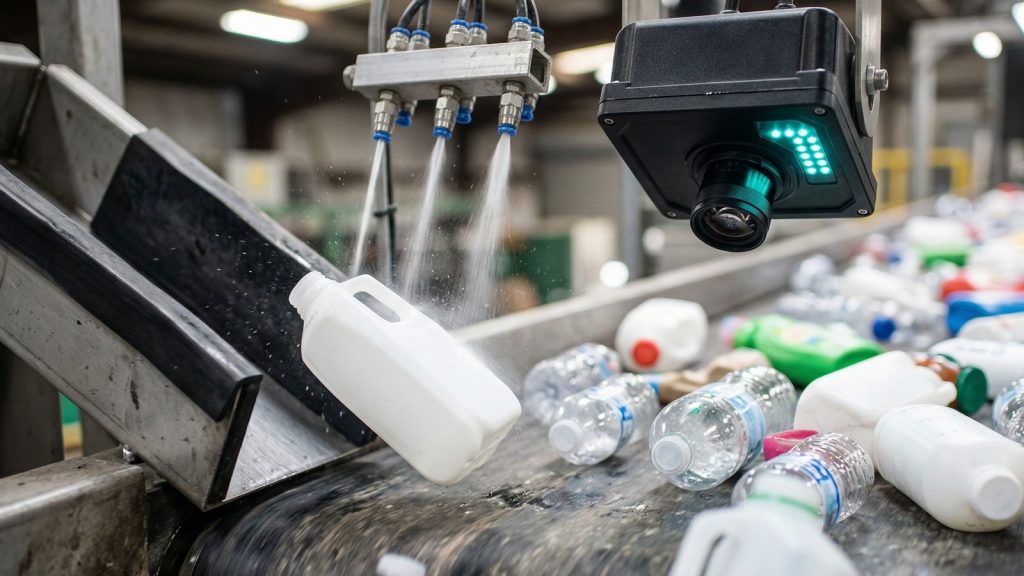
Material spreads out on a fast conveyor. A lamp shines infrared light onto it.
A sensor above the belt reads the reflected light thousands of times a second. Software matches each reading against a library of known fingerprints.
At the end of the belt, a row of air jets fires. The right jets fire at the right moment and blow the target item off its path into a separate chute.
Everything else falls straight off the end.
How fast and how accurate
NIR sorters process 200 to 400 items per second, deciding in under 100 milliseconds [1].
Throughput is typically 6 to 10 tonnes an hour for general-purpose machines and 18 to 35 tonnes an hour for high-capacity machines, depending on belt width and material [1][5]. A market report puts accuracy at around 96.8 per cent, compared to 78.4 per cent for systems that only look at colour [1].
The same report gives, for specific polymers: 97.1 per cent for PET, 96.4 per cent for HDPE, 94.8 per cent for LDPE [1].
What NIR cannot do
Black plastic is the classic failure. Carbon black pigment absorbs almost all infrared light, so nothing reflects back and the sensor sees nothing.
Multi-layer packaging is the other problem. A pouch made of three bonded polymers returns a confused signature.
Very thin film can be too transparent to read. Wet or dirty material gives a signal from the contamination rather than the item.
Preparation matters more than the machine
This is the point most buyers miss. A sorter only performs on material it was designed to see.
Items need to be spread in a single layer, not piled. They need a consistent size. Fragments between 10 and 50 mm give the most stable reading [2].
Poor preparation cuts accuracy by 15 to 20 per cent [2]. That is a bigger effect than the difference between machine brands.
Adding AI
Newer machines combine NIR with a camera and machine learning. NIR gives the chemistry. The camera gives shape, size and colour.
Together they handle cases neither manages alone. Adding AI has raised accuracy from 87 per cent to over 98 per cent [1].
Combining sensors
NIR is often paired with X-ray. X-ray finds metals at 99.1 per cent purity while NIR sorts the plastics, with combined throughput of 8 to 22 tonnes an hour [1].
Cost
An NIR system costs roughly USD 680,000 to 1.2 million [1]. Colour sorting is cheaper at USD 180,000 to 420,000. Laser is dearer at USD 1.2 to 2.8 million [1].
In the Gulf
Abu Dhabi’s greenfield material recovery facility, awarded to Urbaser for 2028 operation, will process 400,000 tonnes a year using automated sorting with optical technologies and AI [3].
Tadweer expects those facilities to recover 15 to 20 per cent of incoming waste, supporting the target of 80 per cent landfill diversion by 2031 [4].
Professional layer — engineering, operations & compliance detail (click to expand)
Professional
Spectroscopic principle
NIR sorting exploits molecular vibrational overtones and combination bands in the 900 to 2,500 nm region [1]. Absorption at specific wavelengths corresponds to C-H, O-H and N-H bond vibrations, and the resulting absorbance profile differentiates polymers by chemical structure rather than appearance.
This is the decisive advantage over colour sorting, which classifies by visible reflectance alone and cannot distinguish a clear PET bottle from a clear PVC bottle. Market-report figures put the indicative accuracy differential at 96.8 per cent for NIR against 78.4 per cent for colour-based systems [1], though no test conditions are stated.
Practical implementations use linear array sensors scanning across the belt. Market-leading platforms are specified with 2,048-pixel linear sensors and process around 12 gigabytes of spectral data per unit per day [1].
Throughput and machine specification
Published throughput bands vary by configuration and should be read against belt width and material type.
General-purpose NIR sorting is rated at 6 to 10 tonnes per hour in comparative tables [5], while high-capacity platforms are rated at 18 to 35 tonnes per hour [1]. Chute-type machines handling free-flowing granular material typically run 1 to 10 tonnes per hour; belt-type units handling larger or irregular items reach up to 15 tonnes per hour [6].
Ejection response times under 5 milliseconds are achievable with matrix ejector arrays [6]. System-level response, from detection to valve actuation, is quoted under 100 milliseconds [1].
Belt width and speed set the relationship between throughput and accuracy. Increasing belt speed raises nominal throughput but reduces dwell time under the sensor and increases the positional error between detection and ejection. Accuracy figures quoted by suppliers assume a specified belt loading; they do not survive overloading.
Feedstock preparation as the controlling variable
Preprocessing determines whether rated accuracy is attainable.
Shredding, washing, drying and screening produce uniform particle size and reduce surface contamination. Fragments between 10 and 50 mm present a consistent scanning surface to NIR and AI systems [2]. Inadequate preprocessing causes signal interference that reduces precision by as much as 15 to 20 per cent [2].
Singulation matters as much as sizing. Overlapping items produce a composite spectrum that matches nothing in the library, and the item is rejected to residue. Burden depth control through vibratory feeders and accelerating belts is a design requirement, not an accessory.
Moisture is a specific problem in washed streams. Surface water has strong NIR absorption bands that mask the substrate signature, which is why drying precedes spectral sorting in wash lines.
Known material limitations
Carbon black pigmented plastics absorb across the NIR range and return insufficient reflected signal for classification. Detection of black plastics is an active development area, addressed through mid-infrared sensing, laser-induced approaches and alternative pigment specification upstream [7].
Multi-layer laminates return a mixed or surface-dominated signature that does not correspond to the bulk composition. The identification may be correct for the outer layer and wrong for the article.
Thin transparent film may transmit rather than reflect, giving a reading dominated by the belt or the material beneath.
Heavily soiled or labelled items return the signature of the contaminant or the sleeve. Full-body shrink sleeves on PET bottles are a well-known misclassification source.
Sensor fusion
Combining modalities addresses the individual blind spots.
NIR with visible spectrometry adds colour discrimination for applications such as clear versus coloured PET, and is the basis of dual-sensor platforms processing up to 10 tonnes per hour on a 2.8 metre belt [5].
NIR with X-ray transmission adds density and atomic number discrimination, identifying ferrous and non-ferrous metals at 99.1 per cent purity while NIR handles the polymer fractions, at combined throughput of 8 to 22 tonnes hourly [1].
NIR with AI vision adds contextual recognition of shape, size, opacity and brand, and the integration has been reported to raise real-time classification accuracy from 87 per cent to over 98 per cent while reducing operational downtime [1].
Hyperspectral imaging extends the approach to distinctions invisible to standard NIR, including food-grade versus non-food-grade plastics and flame-retardant additives [5]. That capability matters directly for closed-loop food-contact recycling, where provenance must be demonstrated rather than assumed.
Line integration
Position NIR downstream of size screening, ballistic separation and metal removal. Sending unscreened mixed material to a spectral sorter wastes its capability on separations that cheaper equipment performs better.
Sequencing AI pre-sorting ahead of NIR reduces contaminant load on the spectral stage, improving accuracy and extending service life, with integrated line design reported to reduce operational costs by up to 15 per cent [2].
Multiple NIR passes are normal for high-purity output. A first pass performs a coarse polymer split; subsequent passes clean each fraction. Purity targets above 95 per cent generally require at least two passes plus quality control.
Typical achieved purity in production is 95 to 99 per cent, which is the level at which recycled resin competes commercially with virgin material [8].
Cost and selection
Indicative system costs and accuracy claims by technology, as cited in a commercial market report and not independently verified [1]:
- NIR: USD 680,000 to 1.2 million, 42.3 per cent market share, 96.8 per cent accuracy.
- X-ray: USD 800,000 to 1.8 million, 97.2 per cent accuracy, metals and e-waste.
- Colour: USD 180,000 to 420,000, 78.4 per cent accuracy, glass.
- Laser: USD 1.2 to 2.8 million, 94.6 per cent accuracy, contaminant identification.
Selection follows the output specification, not the headline accuracy. If the offtake contract requires 98 per cent purity food-grade PET, the specification is a multi-pass NIR line with hyperspectral capability and quality control. If it requires a mixed polymer fraction for energy recovery, that capital is wasted.
For Gulf operators, the relevant near-term application is the automated recovery capacity now being built. Abu Dhabi’s 400,000 tonne per year facility, 200,000 tonnes MSW and 200,000 tonnes commercial and industrial, is specified around automated sorting supported by optical technologies and AI, with recovered material prepared for reuse or onward processing at the waste-to-energy facility under development [3].
Across the UAE and the wider GCC, the binding constraint on optical sorting performance is inbound segregation rather than sensor capability. Where a single communal bin delivers mixed and soiled material, a machine rated at 96.8 per cent on prepared feedstock will not reach it. That is why Abu Dhabi’s two-bin household pilot and its automated recovery investment are one programme, not two [4].
Frequently asked questions
Why can NIR not sort black plastic? Carbon black pigment absorbs across the near-infrared range, so too little light reflects back for the sensor to classify the item [7].
What accuracy is realistic? Market-report figures cite around 96.8 per cent overall, with 97.1 per cent for PET, 96.4 per cent for HDPE and 94.8 per cent for LDPE on prepared feedstock [1]. Treat these as indicative and ask suppliers for test results on your own feedstock under stated conditions.
What throughput can one machine handle? Between 6 and 10 tonnes per hour for general-purpose units, and 18 to 35 tonnes per hour for high-capacity platforms [1][5].
Why does my sorter underperform its rating? Almost always feedstock preparation. Poor sizing, overlapping items or moisture cut precision by 15 to 20 per cent [2].
How many passes are needed for high purity? Purity above 95 per cent generally requires at least two NIR passes plus a quality control stage [8].
References
Show all 8 sources
- Dataintelo. Optical Sorting Machines for Waste Recycling Market Research Report. May 2026. Accessed: 7 September 2026.
- AI Sorting Machine. A Comprehensive Guide to Selecting Waste Sorting Machines for Mixed Plastic Recycling. Accessed: 7 September 2026.
- Utilities Middle East. Tadweer awards Abu Dhabi waste recovery facility contract to Urbaser. July 2026. Accessed: 7 September 2026.
- The National. Abu Dhabi to significantly cut landfill use in sweeping waste overhaul. 17 July 2026. Accessed: 7 September 2026.
- Waste Technology UK. Best Automatic Waste Sorting Machine Models and Options. February 2026. Accessed: 7 September 2026.
- AI Sorting Machine. NIR Sorter: Smart Material Sorting Based on Near-Infrared, technical specifications. Accessed: 7 September 2026.
- AI Sorting Machine. How High-Speed NIR Plastic Sorting Machines are Revolutionizing Recycling. Accessed: 7 September 2026.
- AI Sorting Machine. NIR sorter purity performance in industrial-scale plastic recycling. Accessed: 7 September 2026.
Related articles
- Manual vs automated sorting
- AI-powered sorting and robotics
- Material recovery facilities
- Eddy current and magnetic separation
- Ballistic separators
- Plastics recycling
- Plastic waste
- Segregation at source
- Waste management in the Gulf context
About this article
Charmaine Frost is a landfill gas and waste-management specialist and a founding director of Qualifrost FZC LLC. Her experience was gained with major UK waste-management companies, covering landfill gas generation and collection systems, environmental monitoring and the practical risks of landfill operations. She holds the NEBOSH International General Certificate and has submitted her final NEBOSH Diploma assessment, with results expected in March–April 2027.
Reviewed by Adrian Frost, Director. Every article is checked against primary sources before publication: legal claims are verified against the instrument itself, and figures against the cited source.
Published 25 August 2026 · Last reviewed 25 August 2026 · Next review August 2027, or sooner if the law changes.