

Rubber and Tyre Recycling: Shredding, Pyrolysis and Devulcanisation
A tyre is engineered never to break down, which is exactly what makes it a disposal problem. This guide covers the three recovery routes, shredding to crumb rubber, pyrolysis, and devulcanisation, with the yields, market realities and the Abu Dhabi projects that show what works and what does not.
By Charmaine Frost, Director and Landfill Gas Specialist
In short
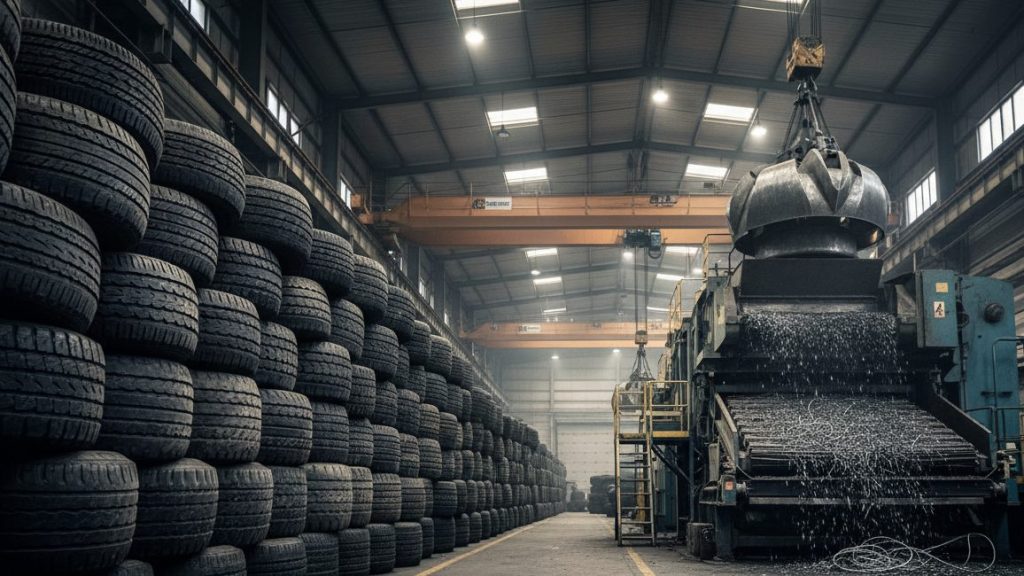
End-of-life tyres are recovered through three routes. Mechanical shredding to crumb rubber is the dominant material route and is proven in the UAE. Energy recovery uses tyre-derived fuel with a calorific value of 28 to 38 MJ/kg, comparable to coal. Pyrolysis thermally decomposes rubber into oil, carbon black and steel. Across the EU and UK in 2021, 51 per cent of end-of-life tyres went to crumb and 42 per cent to energy recovery. Tyres are roughly 10 to 15 per cent steel by mass and rubber can persist for up to 1,000 years. Tadweer has expanded Abu Dhabi tyre processing capacity from 70,000 to 100,000 tonnes per year.
- 1CollectionEnd-of-life tyres collected and stored safely
- 2ShreddingTyres cut into chips
- 3GranulationSteel and fibre removed from the rubber
- 4Crumb and powderGraded rubber for new products
- 5End usesSurfaces, moulded products or tyre-derived fuel
Key facts
- End-of-life tyres have a calorific value of 28 to 38 MJ/kg, placing tyre-derived fuel in the same range as coal [1].
- Tyres contain 10 to 15 per cent steel by mass, recovered as a saleable by-product in shredding and pyrolysis routes; in cement kilns the iron is incorporated into the clinker [1].
- Across the EU and UK in 2021, 51 per cent of end-of-life tyres were processed into crumb rubber and 42 per cent went to energy recovery [1].
- Tadweer expanded its Abu Dhabi tyre recycling facility from 70,000 to 100,000 tonnes per year with an Italian technology partner [2].
- A Global Rubber Facility in Al Ain was established with a minimum capacity of 24,000 tonnes per year (the reported 120 tonnes per day corresponds to about 200 operating days a year; verify against the operator’s announcement), at an investment of AED 50 million [3].
- Commercial crumbing plants operate at 6,000 to 8,000 kg per hour producing 0.5 to 4 mm granules at 99 per cent freedom from steel and impurities, with around 40 per cent of output exported [4].
- Rubber can take up to 1,000 years to decompose, and vulcanisation cross-links are what make it chemically resistant to simple reprocessing [8].
- An awarded Abu Dhabi tyre pyrolysis project was never established, and a separate crumbing project bought machinery but never operated [2].
Plain English — the essentials, in everyday language
Plain English
Why tyres are difficult
A tyre is designed to survive heat, water, sunlight, oil and constant flexing for years. That durability does not switch off at end of life.
Rubber can take up to 1,000 years to decompose [8]. Whole tyres also trap air, so they float up through landfill and destabilise the cap. Most jurisdictions ban them from landfill for that reason.
The vulcanisation problem
Raw rubber is soft and sticky. Vulcanisation uses sulphur to create cross-links between the polymer chains, turning it into a tough elastic solid.
Those cross-links are permanent. You cannot melt vulcanised rubber and remould it the way you can melt a thermoplastic.
That single fact shapes the entire recycling industry. Everything else is a workaround.
What a tyre is made of
A passenger tyre is roughly 45 to 50 per cent rubber, both natural and synthetic. Around 20 to 25 per cent is carbon black and silica filler.
Steel makes up 10 to 15 per cent, in the belts and the bead. Textile cord accounts for a few per cent, along with sulphur, zinc oxide and oils.
Every route has to deal with all four materials.
Route one: shredding to crumb rubber
This is the dominant material recovery route and the one that works reliably.
Tyres are shredded into chips, then granulated further. Magnets pull out the steel. Air classification removes the textile fibre.
The output is crumb rubber in graded sizes. Commercial plants run at 6,000 to 8,000 kg per hour producing 0.5 to 4 mm granules, at 99 per cent freedom from steel and impurities [4].
What crumb rubber is used for
Sports pitches and playground surfacing are the largest markets. Rubber-modified asphalt is growing. Moulded products include mats, tiles and paving.
The limitation is that crumb is a filler, not a feedstock. You are not making new tyres from it. That is downcycling, and it caps the value.
Route two: energy recovery
Tyre-derived fuel has a calorific value of 28 to 38 MJ/kg, which is comparable to coal [1].
Cement kilns are the main user. The high temperature destroys organics completely, and the steel and zinc are absorbed into the clinker chemistry rather than becoming ash.
Across the EU and UK in 2021, 42 per cent of end-of-life tyres went to energy recovery against 51 per cent to crumb [1].
Route three: pyrolysis
Pyrolysis heats tyres without oxygen so they decompose rather than burn. It yields oil, a carbon black char, a combustible gas and clean steel.
In principle this recovers chemical value rather than just calorific value. In practice it has been commercially difficult almost everywhere.
The core problem is char quality. Pyrolytic carbon black contains ash and inorganic residue, so it does not match virgin carbon black specification and sells at a discount.
Route four: devulcanisation
Devulcanisation attempts the thing that seems impossible: breaking the sulphur cross-links so the rubber can be reprocessed as rubber.
Methods include mechanical shear, ultrasound, microwave and chemical or biological agents.
The difficulty is selectivity. Processes that break cross-links also tend to break the main polymer chains, which degrades the material. It remains largely small-scale.
What has actually happened in the UAE
The record here is instructive and worth being direct about.
Crumbing is proven. Tadweer expanded its Abu Dhabi tyre facility from 70,000 to 100,000 tonnes per year with an Italian partner [2]. A Global Rubber Facility in Al Ain was established at a minimum 24,000 tonnes per year (a reported 120 tonnes per day, which corresponds to about 200 operating days a year), for AED 50 million [3].
Pyrolysis has not been. An awarded Abu Dhabi tyre pyrolysis project was never established. A separate crumbing project bought machinery but never operated [2].
Around 40 per cent of UAE crumb output is exported [4], which tells you the domestic offtake market is the constraint rather than the processing capacity.
Professional layer — engineering, operations & compliance detail (click to expand)
Professional
Material composition and its consequences
Composition determines which routes are viable and what by-product revenue is available.
Steel at 10 to 15 per cent by mass is the most reliable secondary revenue stream [1]. It is recovered magnetically in shredding and as a clean solid residue in pyrolysis, where the absence of rubber makes it a higher-grade scrap product.
The rubber fraction combines natural and synthetic polymers, principally styrene-butadiene and polybutadiene, cross-linked with sulphur [8]. Carbon black and silica fillers are chemically bound into the matrix and cannot be separated mechanically.
Textile cord, typically polyester or nylon, is removed by air classification during granulation and is generally a low-value or negative-value residue.
Zinc oxide, present as a vulcanisation activator, is the constituent that most affects thermal routes. Zinc reports to ash or clinker and constrains where tyre-derived fuel can be used.
Mechanical processing and crumb specification
The processing sequence is: whole tyre reception, primary shredding to 50 to 300 mm chips, secondary granulation, magnetic separation of steel, air classification or vacuum extraction of textile fibre, screening to graded fractions, and quality control.
Commercial throughput at 6,000 to 8,000 kg per hour with output at 0.5 to 4 mm and 99 per cent freedom from steel and impurities [4] represents current production practice rather than a theoretical maximum.
Grade determines market. Coarse shred goes to civil engineering fill and landfill drainage layers. Granulate at 1 to 4 mm serves sports surfacing and moulded products. Fine crumb below 1 mm is required for rubber-modified asphalt and higher-value compounding, and finer grinding increases energy cost disproportionately.
Cryogenic grinding using liquid nitrogen embrittles the rubber and produces finer, more regular particles with cleaner fracture surfaces. It commands a price premium but the nitrogen cost is substantial, and ambient grinding dominates by volume.
End markets and the downcycling ceiling
The structural limitation of mechanical recycling is that crumb rubber functions as a filler in a new matrix, not as a feedstock for new rubber. Vulcanisation cross-links persist through grinding, so the particles do not co-vulcanise into a new compound at high loading.
Practical inclusion rates in new rubber goods are therefore low, typically single-digit percentages, before mechanical properties degrade.
This caps the addressable market and makes crumb demand the binding constraint rather than supply. The UAE position, with around 40 per cent of crumb output exported [4], is a direct expression of that: processing capacity exists, local offtake does not absorb it.
Market development is consequently the higher-return intervention. Specifying rubber-modified asphalt in road contracts, or recycled rubber content in public realm surfacing, creates demand that no amount of additional processing capacity can substitute for.
Regulatory attention to infill in synthetic sports pitches, driven by microplastic release concerns, is a live risk to the largest single crumb market and should be factored into any long-term offtake assumption.
Energy recovery
Calorific value of 28 to 38 MJ/kg places tyre-derived fuel between bituminous coal and petroleum coke, and it is the reason 42 per cent of EU and UK end-of-life tyres took this route in 2021 [1].
Cement kilns are the dominant outlet for sound technical reasons. Kiln gas residence time and temperature ensure complete destruction of organic compounds. Steel contributes iron to the clinker and zinc is incorporated into the mineral phase rather than reporting to a separate ash stream requiring disposal.
Under the waste hierarchy, energy recovery ranks below material recycling. The defensible position is that tyre-derived fuel is the appropriate route for material that cannot meet crumb specification or for volumes exceeding available material offtake, not the default destination.
For Gulf operators with substantial domestic cement production, this route has lower commercial risk than pyrolysis and provides a floor under tyre collection economics.
Pyrolysis: yields and why projects fail
Pyrolysis decomposes rubber in the absence of oxygen, typically at 400 to 600 degrees Celsius, yielding pyrolysis oil, solid char, non-condensable gas and steel [8].
Indicative mass yields are approximately 40 to 45 per cent oil, 30 to 35 per cent char, 10 to 15 per cent gas and 10 to 15 per cent steel, varying with feedstock and reactor conditions.
The commercial difficulty is concentrated in the char. Recovered carbon black carries ash and inorganic residue from fillers, zinc and sulphur compounds, and does not meet virgin carbon black specification for reinforcing applications. It sells at a discount into lower-grade uses, and upgrading requires additional processing that consumes the margin.
Pyrolysis oil faces a parallel problem. It contains sulphur and aromatics requiring hydrotreatment before it can be used as refinery or petrochemical feedstock, and its value tracks crude oil price, which makes project economics dependent on a commodity the operator cannot hedge.
The UAE record is directly relevant evidence. An awarded Abu Dhabi tyre pyrolysis project was never established, and a separate crumbing project purchased machinery but never entered operation [2]. These outcomes reflect the general pattern in the sector rather than local circumstance.
Where pyrolysis is being considered, the diligence questions are: is there a contracted offtake for the char at a stated specification and price, is there a contracted route for the oil including any hydrotreatment, and is the project economics viable at the low end of the oil price range rather than the high end.
Devulcanisation
Devulcanisation is the only route that would return tyre rubber to rubber rather than downcycling it, which is why it continues to attract research attention despite limited commercial deployment.
Approaches divide into mechanical and thermomechanical shear, ultrasonic, microwave, chemical using disulphides or other agents, and biological using sulphur-oxidising microorganisms [8].
The governing technical problem is selectivity. The sulphur-sulphur and carbon-sulphur bonds targeted for scission have bond energies comparable to the carbon-carbon bonds of the polymer backbone. Processes energetic enough to break cross-links also break main chains, reducing molecular weight and degrading the mechanical properties of the recovered material.
Devulcanised rubber is consequently used at partial replacement levels in new compounds rather than as a complete substitute, and output quality is sensitive to feedstock consistency.
For an operator, devulcanisation is currently a technology to monitor rather than to specify.
Regional infrastructure and strategy
Abu Dhabi’s capacity position is established. Tadweer expanded its tyre recycling facility from 70,000 to 100,000 tonnes per year in partnership with an Italian technology provider, and a Global Rubber Facility in Al Ain was established at a minimum 24,000 tonnes per year, with a reported 120 tonnes per day corresponding to about 200 operating days a year, at AED 50 million investment [3].
Three strategic points follow for UAE and GCC operators.
Capacity is not the constraint. Crumb output is already being exported at around 40 per cent, indicating that domestic demand development is the limiting factor.
Proven technology should be preferred. Crumbing works here; pyrolysis has a documented record of awarded projects that did not proceed. Technology selection should weight regional operating evidence heavily.
Tyres support the wider diversion target. Tadweer’s objective of diverting 80 per cent of Abu Dhabi’s waste from landfill by 2031, supported by expanding recovery infrastructure including the 400,000 tonne per year facility awarded to Urbaser for 2028 operation [5][6], requires bulky non-municipal streams such as tyres to have reliable routes.
Under UAE Federal Law No. 12 of 2018, Article 10 provides that usable secondary raw materials are not waste where they can be used in the same or another industry, which supports the commercial treatment of crumb rubber and recovered steel as products rather than regulated waste. Article 7 permits the Ministry to compel reuse or recycling where less harmful than disposal [7].
Frequently asked questions
Why can tyres not simply be melted and remoulded? Vulcanisation creates permanent sulphur cross-links between polymer chains, so the rubber is a thermoset and does not melt.
What is the calorific value of tyre-derived fuel? Between 28 and 38 MJ/kg, comparable to coal, which is why cement kilns are the main user [1].
What proportion of tyres is recycled versus burned? Across the EU and UK in 2021, 51 per cent went to crumb rubber and 42 per cent to energy recovery [1].
Why does tyre pyrolysis struggle commercially? Recovered carbon black carries ash and inorganic residue so it sells below virgin specification, and pyrolysis oil needs hydrotreatment while tracking crude oil price.
What capacity exists in Abu Dhabi? Tadweer expanded its facility from 70,000 to 100,000 tonnes per year [2], and a Global Rubber Facility in Al Ain operates at a minimum 24,000 tonnes per year [3].
References
Show all 8 sources
- European Tyre and Rubber Manufacturers Association. End-of-life tyre management: EU and UK recovery route data for 2021. Accessed: 7 September 2026.
- Tadweer Group. Abu Dhabi tyre recycling facility capacity expansion from 70,000 to 100,000 tonnes per year. Accessed: 7 September 2026.
- Global Rubber Facility, Al Ain: minimum 24,000 tonnes per year capacity and AED 50 million investment. Publisher, URL, facility name and figures to be verified against the operator’s or official announcement. Accessed: 7 September 2026.
- Commercial tyre crumbing plant specifications: throughput, granule sizing and purity performance. Accessed: 7 September 2026.
- The National. Abu Dhabi to significantly cut landfill use in sweeping waste overhaul. 17 July 2026. Accessed: 7 September 2026.
- Utilities Middle East. Tadweer awards Abu Dhabi waste recovery facility contract to Urbaser. July 2026. Accessed: 7 September 2026.
- UAE Federal Law No. 12 of 2018 on Integrated Waste Management, Articles 7 and 10. Accessed: 7 September 2026.
- Royal Society of Chemistry. Recent advances in chemical recycling and upcycling of plastic and polymer waste. January 2026. Accessed: 7 September 2026.
Related articles
- Tyre waste
- Chemical and advanced recycling
- Plastics recycling
- Metal recycling
- Eddy current and magnetic separation
- Bulky and special waste
- The waste hierarchy
- Principles of circular economy
- Waste management in the Gulf context
About this article
Charmaine Frost is a landfill gas and waste-management specialist and a founding director of Qualifrost FZC LLC. Her experience was gained with major UK waste-management companies, covering landfill gas generation and collection systems, environmental monitoring and the practical risks of landfill operations. She holds the NEBOSH International General Certificate and has submitted her final NEBOSH Diploma assessment, with results expected in March–April 2027.
Reviewed by Adrian Frost, Director. Every article is checked against primary sources before publication: legal claims are verified against the instrument itself, and figures against the original dataset.
Published 25 August 2026 · Last reviewed 25 August 2026 · Next review August 2027, or sooner if the law changes.